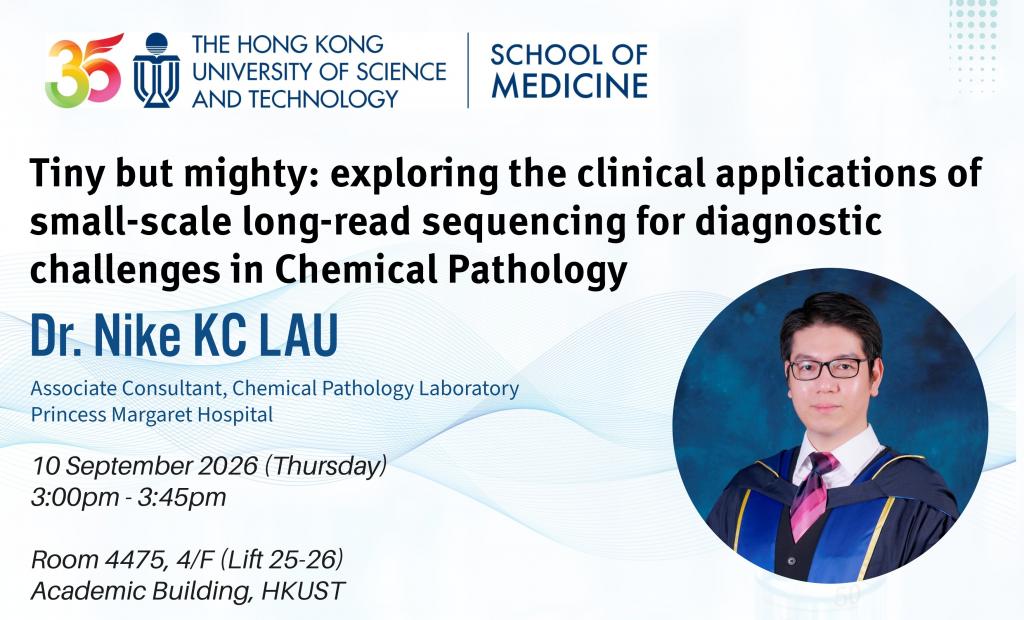
Tiny but Mighty: Exploring the Clinical Applications of Small-scale Long-read Sequencing for Diagnostic Challenges in Chemical Pathology
Supporting the below United Nations Sustainable Development Goals:支持以下聯合國可持續發展目標:支持以下联合国可持续发展目标:
In clinical practice, we often encounter challenging cases in which contemporary techniques cannot always provide a complete diagnosis. This challenge is especially relevant to inherited disorders, for which the exact genetic aetiology may remain unknown even after a lengthy diagnostic odyssey. Recent advances in sequencing technologies have created new approaches to investigating genomic variation.
Driven by unmet diagnostic needs, we began developing and evaluating nanopore long-read sequencing capability at Princess Margaret Hospital. This session focuses on our experience with Flongle, a compact, lower-cost flow-cell format, suited to focused, small-batch applications. Our long-read workflows characterised complex structural variants and evaluated repeat sizing and sequence interruptions in a proof-of-concept study of trinucleotide-repeat disorders. Ongoing analytical work extends to near-whole mitochondrial DNA sequencing for heteroplasmy measurement and assessment of the feasibility of detecting large deletions, and consensus-based internal transcribed spacer (ITS) sequencing of survey and reference mushrooms for potential toxicology support.
Flongle's small-scale format provides a practical entry point for developing focused long-read applications. These examples demonstrate how we developed laboratory methods, bioinformatics workflows and interpretive experience with long-read sequencing. As experience, evidence and demand grow, the capability built through these projects may support broader applications at greater scale.
Dr Nike KC LAU is a specialist chemical pathologist whose work brings together laboratory medicine, genomics and data science. After completing his medical training at the University of Cambridge and The Chinese University of Hong Kong, he specialised in Chemical Pathology and holds specialist fellowships in Hong Kong (FHKCPath) and Australasia (FRCPA). He also holds a Master of Science in Data Science from The University of Texas at Austin. He is an Associate Consultant Chemical Pathologist at Princess Margaret Hospital, an Honorary Clinical Assistant Professor at CUHK and Vice-President of the Hong Kong Society of Clinical Chemistry.
At Princess Margaret Hospital, he leads the development of nanopore long-read sequencing for clinical applications in response to diagnostic questions. His work spans inherited metabolic disease, repeat expansions and complex structural variants, with a broader interest in translating emerging technologies and artificial intelligence into practical clinical laboratory applications.
For enquiries, please contact Ms. TAM at 3469 2465.
For enquiries, please contact Ms. TAM at 3469 2465.