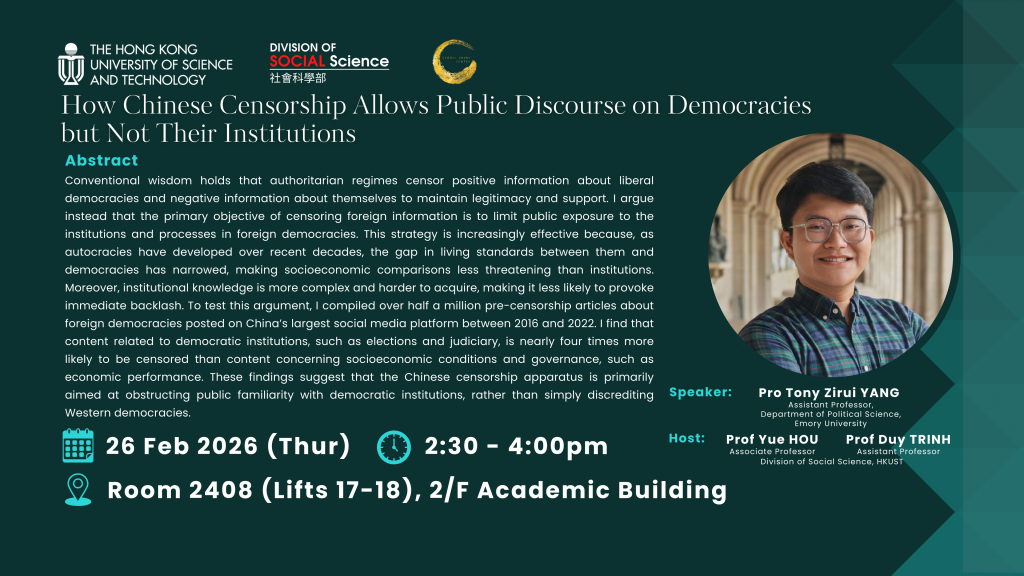
Social Science Seminar - How Chinese Censorship Allows Public Discourse on Democracies but Not Their Institutions
Supporting the below United Nations Sustainable Development Goals:支持以下聯合國可持續發展目標:支持以下联合国可持续发展目标:
Conventional wisdom holds that authoritarian regimes censor positive information about liberal democracies and negative information about themselves to maintain legitimacy and support. I argue instead that the primary objective of censoring foreign information is to limit public exposure to the institutions and processes in foreign democracies. This strategy is increasingly effective because, as autocracies have developed over recent decades, the gap in living standards between them and democracies has narrowed, making socioeconomic comparisons less threatening than institutions. Moreover, institutional knowledge is more complex and harder to acquire, making it less likely to provoke immediate backlash. To test this argument, I compiled over half a million pre-censorship articles about foreign democracies posted on China’s largest social media platform between 2016 and 2022. I find that content related to democratic institutions, such as elections and judiciary, is nearly four times more likely to be censored than content concerning socioeconomic conditions and governance, such as economic performance. These findings suggest that the Chinese censorship apparatus is primarily aimed at obstructing public familiarity with democratic institutions, rather than simply discrediting Western democracies.
Host: Prof Yue HOU, Associate Professor, Division of Social Science, HKUST
Prof Duy TRINH, Assistant Professor, Division of Social Science, HKUST