IPE Thrust Public Seminar | Legislative capacity, bureaucratic reputation, and delegation from a trust perspective: A survey experiment
Supporting the below United Nations Sustainable Development Goals:支持以下聯合國可持續發展目標:支持以下联合国可持续发展目标:
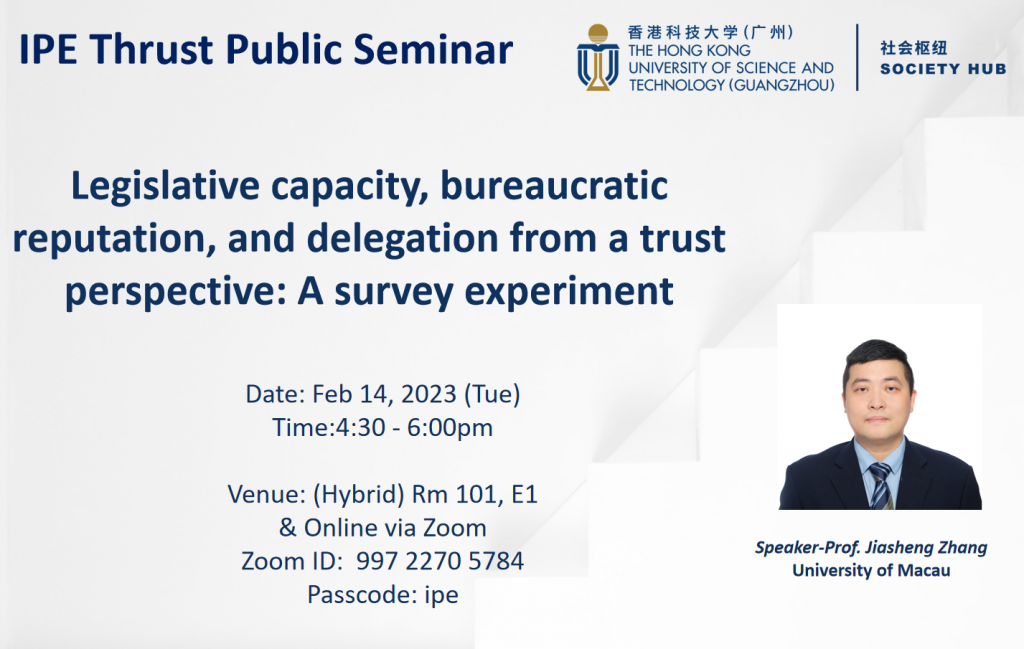
Legislative capacity, bureaucratic reputation, and delegation from a trust perspective: A survey experiment
Abstract:
In this talk, Dr. Zhang will share a recent study on legislative capacity, bureaucratic reputation and discretion. Challenging the assumptions of the principal‐agent theory, the recent bureaucratic politics literature contends that politicians do not necessarily have weaker capacities and bureaucrats are not necessarily bad apples. What this means for the delegation decision remains underexplored, particularly regarding how legislative capacity and bureaucratic reputation jointly affect delegation. The study examines this issue with a trust perspective and a survey experiment of city mayors. Treating bureaucratic reputation as individual trustworthiness and perceived legislative capacity as institutional trustworthiness, the study finds they interact in complex ways in influencing delegation. When bureaucratic reputation is high, perceived legislative capacity is not associated with delegation. Perceived legislative capacity matters only when bureaucratic reputation is low, and high capacity relates to greater delegation willingness than when capacity is not considered. The findings have implications for studies on delegation, discretion, and bureaucratic reputation.
Jiasheng Zhang is Assistant Professor in the Department of Government and Public Administration at the University of Macau. He holds a Ph.D. degree in Public Administration from the Askew School of Public Administration and Policy, Florida State University (FSU).
Dr. Zhang’s research focuses on public management, collaboration, and governance. He is particularly interested in applying quantitative methods, such as experimental design and computational social science methods, to examine issues related to citizen-state interactions, performance information, environmental sustainability and collaborative governance. His research has been published in Public Administration Review, American Review of Public Administration, Public Administration, and other outlets.