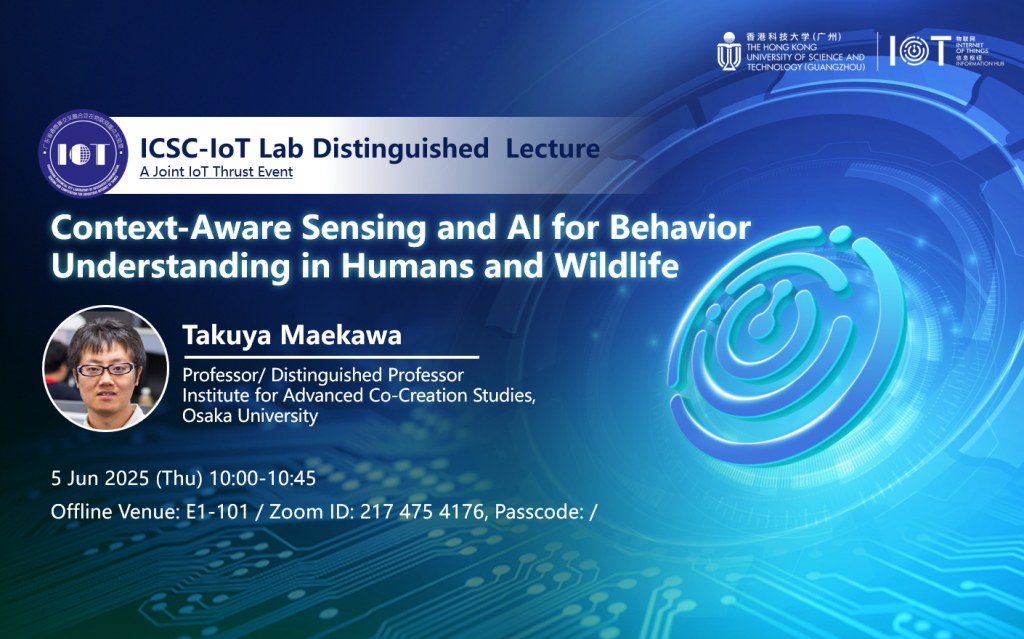
ICSC-IoT Lab Distinguished Lecture | Context-Aware Sensing and AI for Behavior Understanding in Humans and Wildlife
Supporting the below United Nations Sustainable Development Goals:支持以下聯合國可持續發展目標:支持以下联合国可持续发展目标:
This seminar introduces recent trends in sensor-based activity recognition technology. Technology to recognize human activities using sensors has been a hot topic in the field of mobile and ubiquitous computing for many years. Recent developments in deep learning and sensor technology have expanded the application of activity recognition to various domains such as industrial and natural science fields. However, because activity recognition in the new domains suffers from various real problems such as the lack of sufficient training data and complexity of target activities, new solutions have been proposed for the practical problems in applying activity recognition to real-world applications in the new domains. In this seminar, we introduce recent topics in activity recognition from the viewpoints of (1) recent trends in state-of-the-art machine learning methods for practical activity recognition, (2) recently focused domains for human activity recognition such as industrial and medical domains and their public datasets, and (3) applications of activity recognition to the natural science field, especially in animal behavior understanding.
Takuya Maekawa received his B.S., M.S., and Ph.D. degrees from Osaka University, Japan, in 2003, 2004, and 2006, respectively. From 2006 to 2012, he was a researcher at NTT Communication Science Laboratories in Japan. He is currently an associate professor at Osaka University. His research interests include ubiquitous and mobile sensing, web data mining, and information retrieval, and he is now mainly engaged in human activity recognition and indoor positioning research using ubiquitous and wearable sensor data based on machine learning techniques. He has published 36 full papers in top conferences of the mobile/ubiquitous computing research community (PerCom, Ubicomp, IMWUT, ISWC, etc).