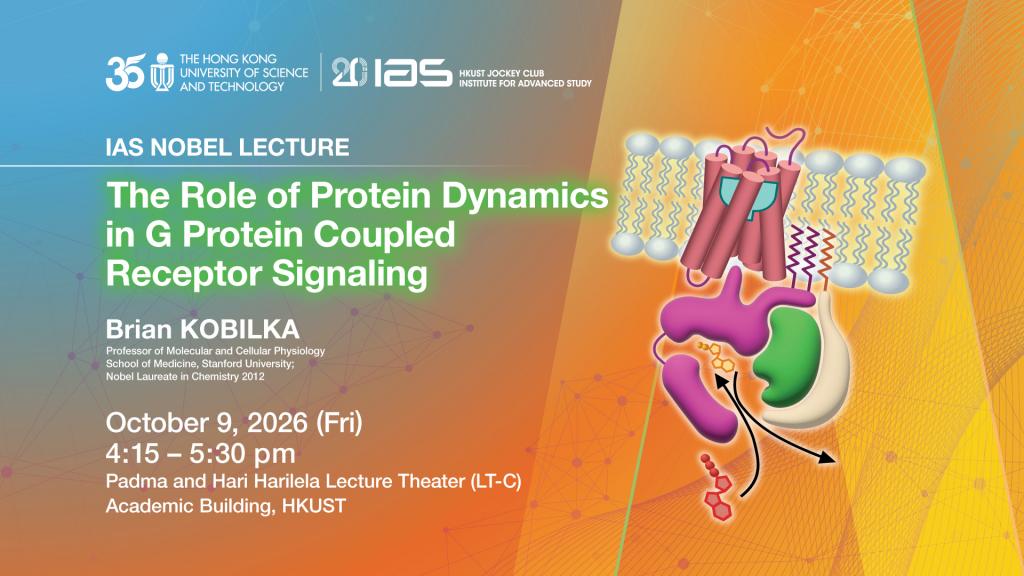
IAS Nobel Lecture - The Role of Protein Dynamics in G Protein Coupled Receptor Signaling
Supporting the below United Nations Sustainable Development Goals:支持以下聯合國可持續發展目標:支持以下联合国可持续发展目标:
Abstract
G protein coupled receptors (GPCRs) conduct the majority of transmembrane responses to hormones and neurotransmitters and mediate the senses of sight, smell and taste. Thanks to advances in protein engineering, crystallography and cryo-electron microscopy (cryoEM) over the past 14 years there are now more than 500 deposited high-resolution structures of GPCRs including inactive states, active states and GPCR-G protein complexes. These structures have provided important insights into common mechanisms of G protein activation for Family A and Family B GPCRs. However, they don’t fully explain the complex behavior of many GPCRs that signal through more than one G protein isoform, and through G protein independent pathways. Moreover, we still do not fully understand the mechanism of G protein coupling specificity. This complex functional behavior provides evidence for the existence of multiple functionally distinct conformational states that may be too transient or unstable to be captured by crystallography or cryoEM. We have used fluorescence, EPR and NMR spectroscopy to study the dynamic properties of several GPCRs. I will discuss a few examples of what these studies have taught us about the role of protein dynamics in GPCR signaling.
About the Speaker
Prof. Brian KOBILKA received Bachelor of Science degrees in biology and chemistry from the University of Minnesota, Duluth in 1977. He graduated from Yale University School of Medicine in 1981 and completed residency training in internal medicine at the Barnes Hospital, Washington University School of Medicine in St. Louis, Missouri in 1984.
In 1984-89, he was a postdoctoral fellow in Dr. Robert LEFKOWITZ’s laboratory at Duke University, where he and his colleagues identified the gene that encodes the receptor for the hormone adrenaline. They found that the receptor was similar to receptors in the eye that capture light. It was later discovered that a family of receptors look and act in similar ways. These G-protein-coupled receptors (GPCRs) are responsible for the body’s response to the majority of hormones and neurotransmitters and are the largest group of targets for new therapeutics for a broad spectrum of diseases.
In 1989, Prof. Kobilka joined the faculty of Medicine and Molecular and Cellular Physiology at Stanford University. He focuses on the structure and mechanism of action of GPCRs. They apply a spectrum of biochemical, biophysical and structural approaches to understand GPCR signalling at the molecular level.
Prof. Kobilka is a member of the National Academy of Sciences, National Academy of Medicine and American Academy of Arts and Sciences. In 2012, he was awarded the Nobel Prize in Chemistry with Lefkowitz for their work on GPCRs.
For Attendees' Attention
Seating is on a first come, first served basis.