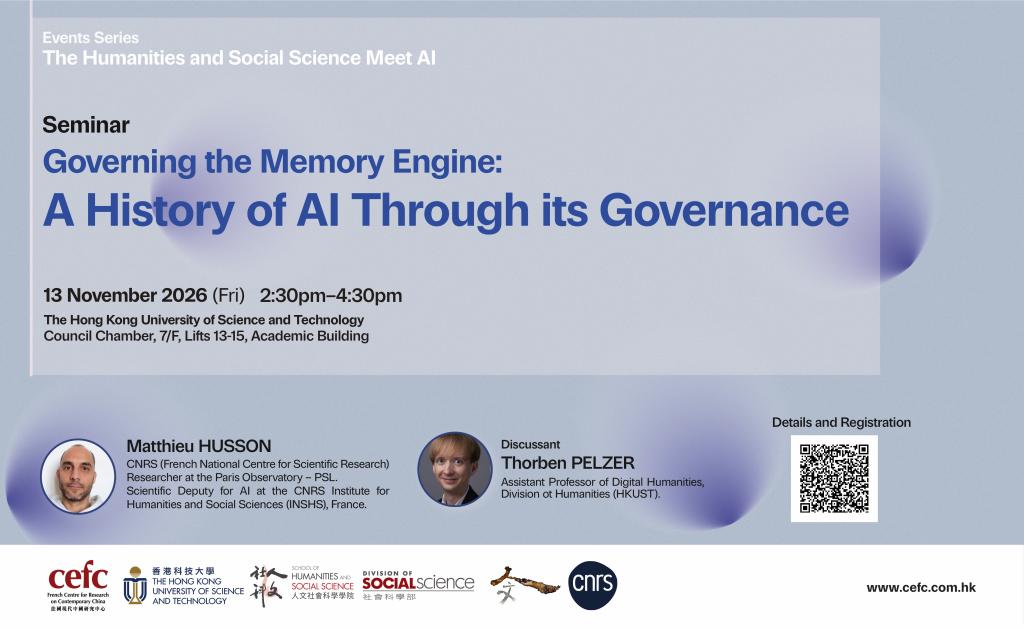
Governing the Memory Engine: A History of AI through its Governance
Supporting the below United Nations Sustainable Development Goals:支持以下聯合國可持續發展目標:支持以下联合国可持续发展目标:
Most histories of artificial intelligence follow one of two paths. Internalist accounts narrate a cumulative progression toward thinking machines; critical accounts diagnose the extraction, labour and surveillance on which today’s systems rest. This lecture presents a third approach, from my book in progress The Inventions of a Future: a history of AI centred not on intelligence but on memory. From the symbolic programs of the 1950s to today’s generative models, AI can be read as an effort to make the archive act: to keep the past in a form that produces decisions. This effort has taken three forms, or memory regimes: rules written by experts and held inside the program; statistical engines coupled to databases they read but do not contain; and large models that absorb their archives into their parameters.
Rather than retelling the technical history, the lecture tests this framework on a question it was not built for: the governance of AI. It argues that governance has attached, in each regime, to wherever memory sits. Funders audited programs whose rules they could read; data-protection law governed files and the decisions drawn from them; courts and legislators now work around models whose memory cannot be separated from the machine, through training data, memorized outputs and computing thresholds. Governance does not only constrain: funding, academic legitimacy, commercial and civil law have also made each regime possible, often before any friction revealed their limits. The lecture closes by asking what the framework explains, where it strains, and who governs AI when memory can no longer be read.