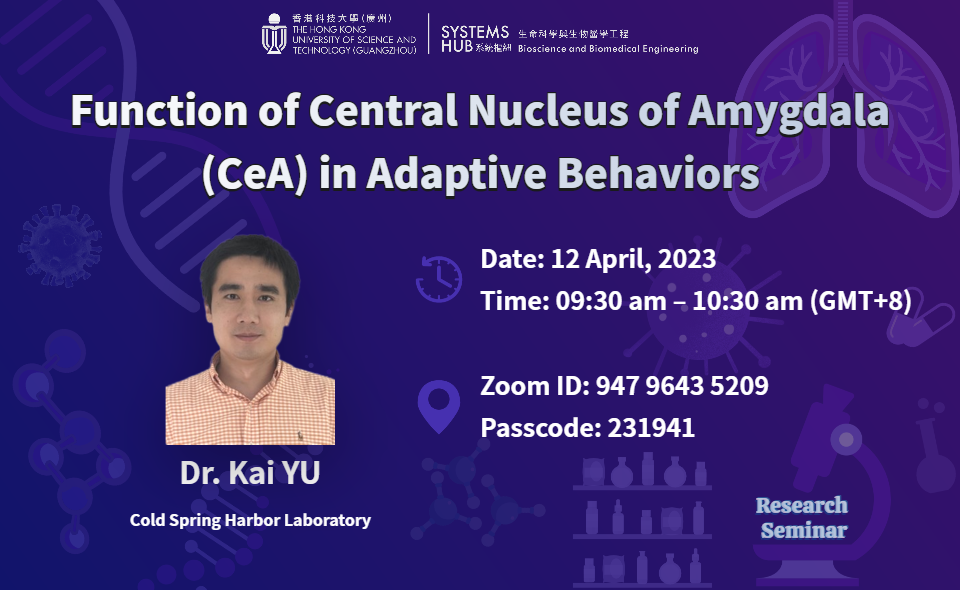
Function of Central Nucleus of Amygdala (CeA) in Adaptive Behaviors
Supporting the below United Nations Sustainable Development Goals:支持以下聯合國可持續發展目標:支持以下联合国可持续发展目标:
ABSTRACT
The central nucleus of amygdala (CeA) plays key roles in a diverse set of adaptive behaviors, including defensive and appetitive response. Early studies of CeA emphasized its function in aversive Pavlovian learning, it was described as a relay connecting basolateral complex of the amygdala to the brainstem effectors. With methodological advances, we demonstrated the somatostatin (SST) expressing neurons in the CeA was actively encoding fear memory through fiber photometry in mice undergoing fear conditioning. Closer observation activities of individual SST+ CeA neurons with endoscopy imaging revealed their roles encoding both aversive and appetitive salient events. In parallel study of PKC-δ -expressing neurons, another major population of the CeA, reveals they are essential for the synaptic plasticity underlying learning in the lateral amygdala, which challenges traditional model of fear learning.
BIOGRAPHY
Dr. Kai Yu is a Research Investigator in the Cold Spring Harbor Laboratory, New York, USA. He received his bachelor’s degree in Science with major of Biology at Wuhan University and Ph.D. in Neuroscience at the Hong Kong Polytechnic University in HKSAR, China. He joined Dr. Bo Li’s lab in 2013 to study the neural circuits underlying behaviors with mouse model, first as a postdoctoral fellow and then as a research investigator.