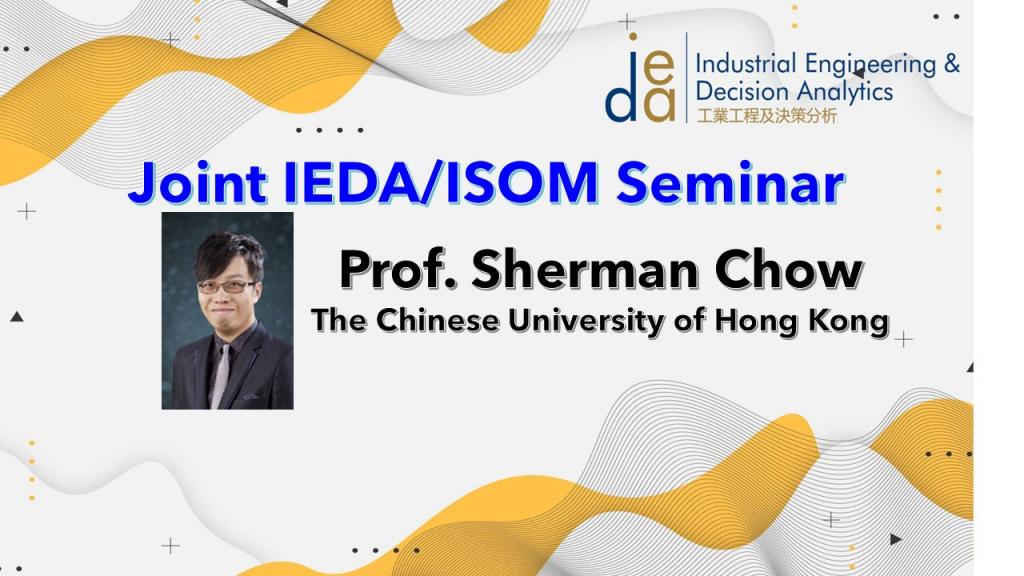
Department of Industrial Engineering & Decision Analytics [Joint IEDA/ISOM] seminar - Screen, Match, Clear: Cryptography for Blindfolded Intermediaries
Supporting the below United Nations Sustainable Development Goals:支持以下聯合國可持續發展目標:支持以下联合国可持续发展目标:
Operations run through intermediaries, and an intermediary earns its keep by seeing everything. A monitor screens what may leave the firm; a server matches records against a query; a processor clears the payment. Seeing everything is also what makes each one a single point of failure: for breach, for surveillance, for censorship. The usual response is to choose an intermediary we trust. This talk asks the opposite: can it be blindfolded and still do the job?
Screen: A gateway can enforce who may send what to whom while learning neither the message nor the policy, and it can do so across organizational boundaries, where senders and receivers answer to different authorities [IEEE S&P 2021].
Match: An encrypted database can accept records from many mutually distrusting writers (no shared secret, no synchronization) and still be searched in sublinear time [USENIX Security 2022].
Clear: A retail payment system can replace the trusted processor with a consortium of competing merchants, settling a customer's coins off-chain while the customer stays anonymous [ICDCS 2021].
In each case the trust is relocated rather than removed, and cryptography is what lets an intermediary keep working on data it cannot read.
Sherman S. M. Chow is an associate professor of The Chinese University of Hong Kong. He received his Ph.D. from New York University and was a research fellow at the University of Waterloo before joining The Chinese University of Hong Kong. His research focuses on cryptography and security, with work spanning privacy-enhancing technologies and secure distributed systems. He serves as a Senior Area Editor for IEEE TDSC and TIFS, is a member of the IETF CFRG Crypto Review Panel, and has served on program committees for major conferences including Asiacrypt, Crypto, Eurocrypt, CCS, NDSS, S&P, and USENIX Security.