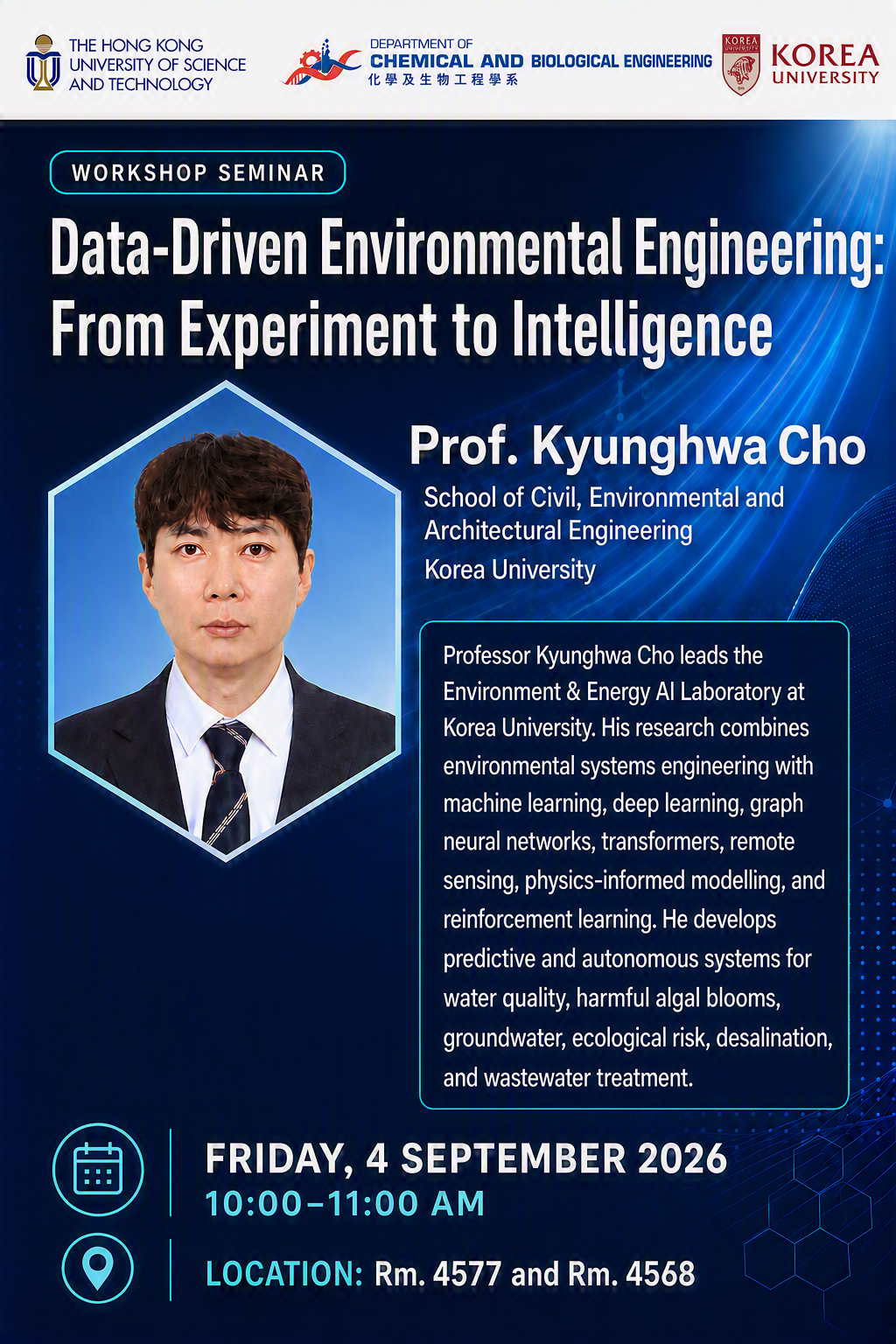
Department of Chemical and Biological Engineering - Data-Driven Environmental Engineering: From Experiment to Intelligence
Supporting the below United Nations Sustainable Development Goals:支持以下聯合國可持續發展目標:支持以下联合国可持续发展目标:
Environmental engineering is advancing from experiment-based analysis to intelligent prediction, optimization, and autonomous control. Artificial intelligence integrates real-time measurements, numerical models, and engineering knowledge to improve the performance, reliability, and adaptability of environmental and energy systems. By learning from complex datasets, these tools can support faster decisions while reducing experimental demands and operating costs.
Applications include reinforcement-learning control of membrane capacitive deionization, multi-agent optimization of two-stage reverse-osmosis processes, and AI-based management of off-grid green-hydrogen production. These approaches enable operating conditions to respond dynamically to changing water quality, energy availability, and treatment objectives. Graph-based AI and explainable machine learning also combine molecular structures, exposure conditions, physical descriptors, and experimental observations to predict aquatic toxicity and clarify adsorption mechanisms.
Together, these approaches transform environmental data into practical intelligence for cleaner water, safer ecosystems, energy-efficient treatment, and sustainable hydrogen production.
Professor Kyunghwa Cho is a Professor in the School of Civil, Environmental and Architectural Engineering at Korea University, where he leads the Environment & Energy AI Laboratory. Prof.Cho received his Ph.D. in Environmental Engineering from the Gwangju Institute of Science and Technology. He conducted postdoctoral research at the University of Massachusetts Amherst and the University of Michigan, Ann Arbor, before joining UNIST in 2013. He served there as an Assistant Professor, Associate Professor, and Professor before joining Korea University in 2023.
His research integrates environmental engineering, water-treatment processes, sustainable energy systems, numerical modelling, and artificial intelligence to develop predictive, interpretable, and autonomous technologies.A central theme of Prof.Cho’s research is transforming conventional environmental processes into intelligent systems. His group develops machine-learning and deep-learning models using laboratory measurements, real-time sensor data, remote-sensing observations, molecular information, and numerical simulations. Its methodological expertise includes time-series modelling, long short-term memory networks, transformers, graph neural networks, multimodal learning, surrogate modelling, physics-informed AI, explainable artificial intelligence, reinforcement learning, multi-agent reinforcement learning, and optimization.
In water and environmental engineering, his research encompasses membrane capacitive deionization, reverse and forward osmosis, ultrafiltration, electrodialysis, membrane-fouling prediction and control, adsorption, advanced oxidation, wastewater reuse, and desalination. His group has developed reinforcement-learning systems that autonomously select operating conditions in response to changing process states while considering treatment performance, energy consumption, water production, and operational stability.
Prof.Cho also applies AI to water-quality forecasting, harmful algal-bloom monitoring, watershed and groundwater modelling, ecological-risk assessment, and the analysis of pathogens, microplastics, emerging contaminants, chemical accidents, arsenic, and radionuclides. His graphical-AI research uses atom-level and fragment-level representations of chemicals and combines molecular structures with exposure and organism information to predict aquatic toxicity. Related studies integrate density-functional-theory calculations, physical and electronic descriptors, and explainable machine learning to investigate adsorption mechanisms.
In sustainable energy, his research addresses seawater-battery desalination and storage, water electrolysis, green-hydrogen production, renewable-energy dispatch, battery-energy-storage systems, and capacity planning for off-grid solar and wind installations.
His research has appeared in journals including Water Research, Journal of Hazardous Materials, Desalination, Applied Energy, Environmental Science & Technology, Chemical Engineering Journal, Journal of Hydrology, and Environmental Modelling & Software. Through his interdisciplinary work, Professor Cho seeks to convert environmental data and scientific knowledge into intelligent solutions for cleaner water, safer ecosystems, resilient infrastructure, and sustainable energy systems.