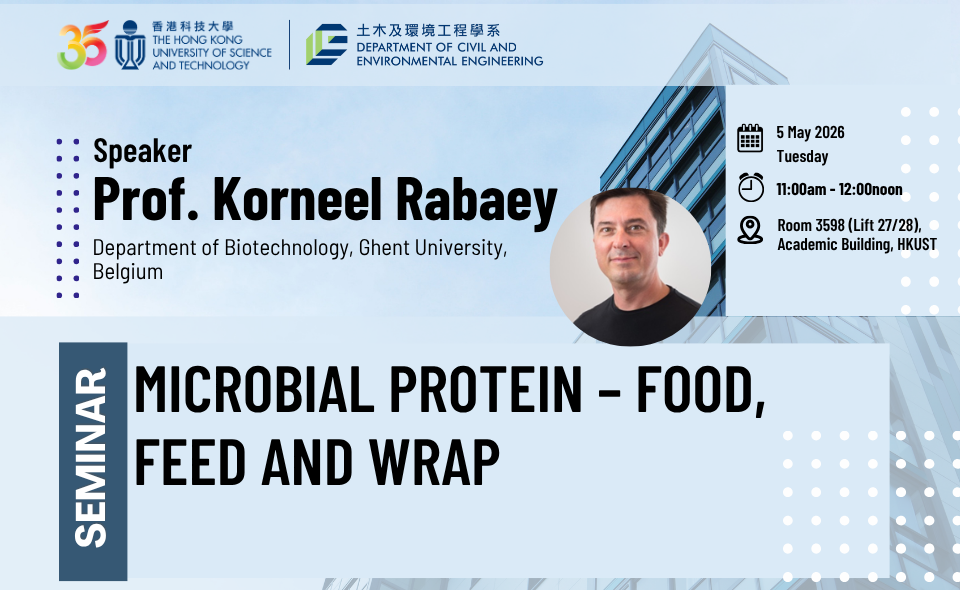
Civil Engineering Departmental Seminar - Microbial protein – food, feed and wrap
Supporting the below United Nations Sustainable Development Goals:支持以下聯合國可持續發展目標:支持以下联合国可持续发展目标:
Microbial protein – food, feed and wrap
Microbial protein (MP) is the protein-rich biomass derived from bacteria, fungi, yeasts, and microalgae. It offers several advantages over plant- or animal-derived proteins, complementing food supply without requiring dedicated arable land as it can be grown in fermenters using using carbon such as CO₂, methane, or organics. The cells can have high protein content and a diverse protein profile. MP can also contribute to a circular society via integration with waste valorization and carbon capture technologies, enhancing circular economy applications. In the past decade, we have produced MP from multiple organic building blocks derived from CO2 or CO, such as methanol, ethanol, acetic acid and formic acid and depending on the substrate, different types of MP can be obtained. In the case of ethanol as substrate, we have scaled up the process and were able to demonstrate with salmon and prawn trials that MP is equivalent to fishmeal. The key hurdles for seeing MP come into daily life are not technological, they are economical and legal. Obtaining approval for novel production chains is highly complicated and lengthy, and overall cost of MP is typically higher than the corresponding feed inputs making the current market mainly for food. An overlooked application of protein is its use as plastics – indeed, today already proteins are used for many packaging applications such as food packaging. Interestingly, even the whole MP (hence the biomass containing protein) can be used for e.g. the production of films. Depending on the type of microorganism, the properties of the plastics (e.g. Young’s modulus) differ indicating that based on the tremendous diversity of the microbial realm a wide array of different plastics could be produced to replace fossil analogues.
Korneel Rabaey is professor at the Department of Biotechnology at Ghent University as well as honorary professor at The University of Queensland. His main research efforts are on resource recovery from biowaste, wastewater, decentralized treatments, industrial liquid sidestreams and CO2 streams from industry. Typically a combination of electrochemical and/or microbial approaches is used to achieve formation of added value products. He is the author or co-author of over 200 refereed articles attracting over 57000 citations, H-index is 108, listing him as an ISI Highly Cited Researcher, and top 2% scientists. He is Fellow of the International Water Association and was laureate of the Royal Academy (Belgium). He is executive editor in chief of Environmental Science & Ecotechnology, as well as Editorial Advisory Board member for Environmental Science & Technology.