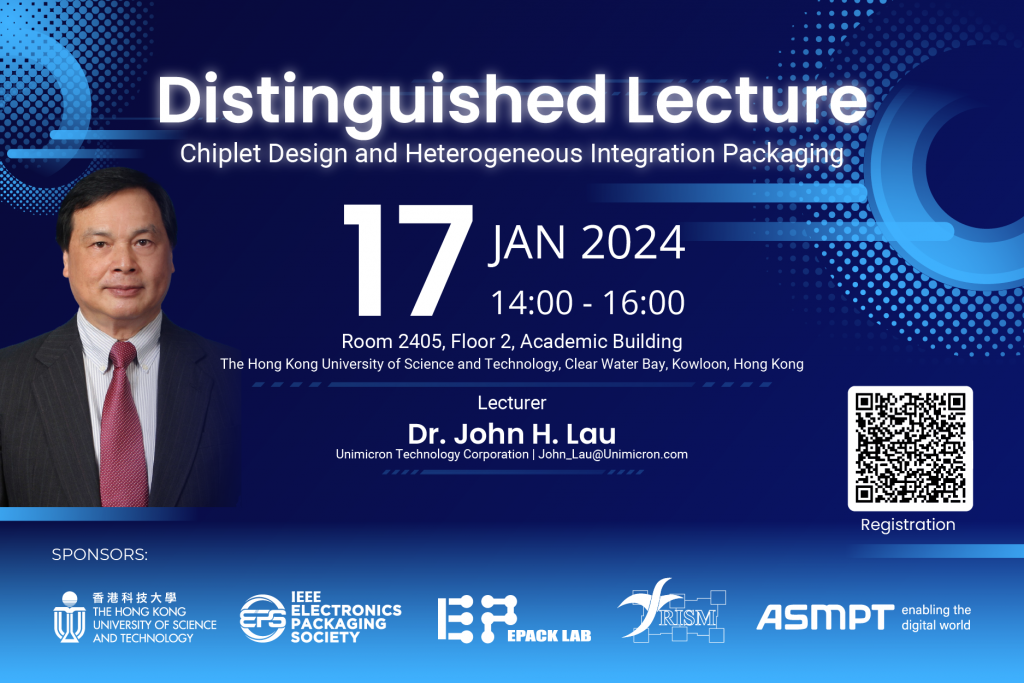
Distinguished Lecture - Chiplet Design and Heterogeneous Integration Packaging
Supporting the below United Nations Sustainable Development Goals:支持以下聯合國可持續發展目標:支持以下联合国可持续发展目标:
Silicon photonics is the semiconductor integration of EIC and PIC on a silicon substrate (wafer) with complementary metal-oxide semiconductor (CMOS) technology. On the other hand, co-packaged optics (CPO) are heterogeneous integration packaging methods to integrate the optical engine (OE), which consists of photonic ICs (PIC) and the electrical engine (EE) which consists of the electronic ICs (EIC) as well as the switch ASIC (application specific IC). The advantages of CPO are: (a) to reduce the length of the electrical interface between the OE/EE (or PIC/EIC) and the ASIC, (b) to reduce the energy required to drive the signal, and (c) to cut the latency which leads to better electrical performance. In the next few years, we will see more implementations of a higher level of heterogeneous integration of PIC and EIC, whether it is for performance, form factor, power consumption, or cost.
Dr. John H. Lau (Life Fellow, IEEE) received his Ph.D. degree from the University of Illinois at Urbana–Champaign, Champaign, IL, USA, in 1977. He was a Senior Scientist/MTS with the Hewlett-Packard Laboratory/Agilent, Palo Alto, CA, USA, for over 25 years. From July 2019 to July 2021, he was the Chief Technology Officer of Unimicron Technology Corporation, where he has been a Senior Special Project Assistant since July 2021. His current research interests include chiplet design and heterogeneous integration packaging, high-density hybrid substrates, organic interposers, TSV interposers, fan-out/fan-in wafer-/panel-level packaging, MEMS, mini-/micro-LED, 3-D IC integration, SMT, and solder joint reliability.
ZOOM: 954 7779 7730
passcode: 000000
Dr. Mian TAO, HKUST EPACK Lab