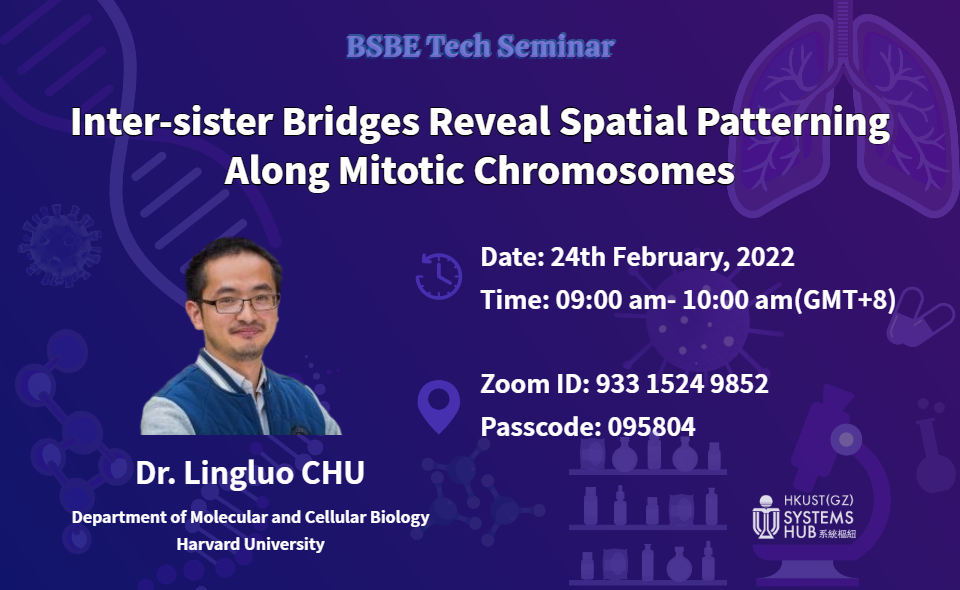
Inter-sister Bridges Reveal Spatial Patterning Along Mitotic Chromosomes
Supporting the below United Nations Sustainable Development Goals:支持以下聯合國可持續發展目標:支持以下联合国可持续发展目标:
ABSTRACT
High resolution imaging of mammalian mitotic chromosomes reveals that sister chromatid axes are linked by dramatically evenly spaced, structurally robust mini-axis bridges from the time they individualize at late prophase through anaphase. Bridges are a new basic feature of sister-chromatid connectedness and their even spacing comprises a unique example of spatial patterning along mitotic chromosomes. Bridges comprise DNA from both sisters plus known axis components. Three unique roles are elucidated. In addition, analysis of axis paths reveals that even spacing of bridges arises by a mechanical process. A two-tiered mechanism is described in which axial torsional stress plays a critical role. These findings illustrate the general principle that mechanical effects can generate spatial patterns along chromosomes. This principle should apply broadly to other features of chromatin and chromosomes, throughout the cell cycle, thus opening the way to investigation and understanding chromosome organization, dynamics and function from a new perspective.
BIOGRAPHY
Dr. Lingluo Chu got his bachelor’s degree from Hefei University of Technology in 2006 (Major in Bioengineering). He graduated, with a PhD in molecular and cell biology, from the University of Science and Technology of China in 2014 followed by a Postdoctoral Fellowship training in biophysics in Nancy Kleckner lab at Harvard University. From Dec. 2019, he becomes a Research Associate Scientist in the Department of Molecular and Cellular Biology at Harvard University.
Dr. Chu’s interest has always been in mitotic chromosome structure and dynamics. Mitosis is the main form of eukaryotic cell division by which duplicated DNA distributes into two daughter cells. Central to mitosis is a set of processes involving chromosome compaction plus resolution and separation of sister chromatids. Aberrancies in these processes underlie many important human diseases, including cancer. Dr. Chu’s research aims at uncovering the molecular and physical mechanisms involved in these critical events. He is especially interested in processes involved in patterning of chromosome shape, dynamic relationships between sister chromatids, and the relationship of these processes to maintenance of genetic stability. The foundation of his research rests with fluorescence imaging of chromosomes, primarily in living cells with uniquely high tempo-spatial resolution, in combination with PROTAC technique, optogenetics, image recognition, machine learning and 3D simulation reconstruction, in normal cells and in cells subjected to precise genetic alterations. Of special interest are indications from his recent work that chromosome conformation (and thus genome stability) is dictated by internal mechanical stress. Those works were published on Molecular Cell (2020), PNAS (2020 and 2022 in press), etc.