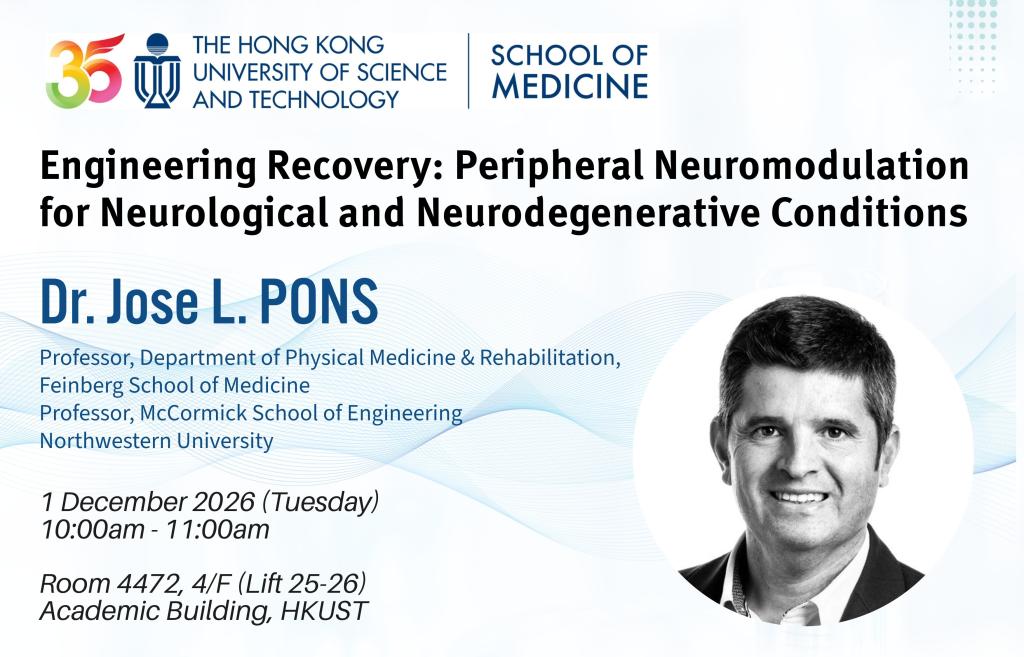
Engineering Recovery: Peripheral Neuromodulation for Neurological and Neurodegenerative Conditions
Supporting the below United Nations Sustainable Development Goals:支持以下聯合國可持續發展目標:支持以下联合国可持续发展目标:
In this lecture, we will analyze how we can develop precision engineered interventions for neurological conditions. The lecture will explore the use of technology-based peripheral interventions to promote neuroplasticity consistent with motor functional improvements after stroke, spinal cord injuries and neurodegenerative conditions such as Parkison's disease and Essential tremor. Along the lecture, Brain-Computer Interfaces, robotics as well as sensory and motor peripheral stimulation techniques will be discussed in the context of precision neurorehabilitation.
Professor, Department of Physical Medicine & Rehabilitation, Feinberg School of Medicine
Professor, McCormick School of Engineering
Northwestern University
Dr. Jose L. Pons graduated in Mechanical Engineering (Universidad de Navarra, Spain, 1992) and obtained a MSc in Information Technologies (Universidad Politécnica de Madrid, Spain, 1994) and a PhD in Physics (Universidad Complutense de Madrid, 1997), for his research work on dynamic optimization of robot mechanisms. Dr. Pons served as the Scientific Chair of the Legs & Walking AbilityLab at Shirley Ryan AbilityLab (formerly the Rehabilitation Institute of Chicago) between 2019-2026. In addition to his research leadership role at SRAlab, he holds appointments as Professor at the Department of Physical Medicine & Rehabilitation, Feinberg School of Medicine and at the Departments of Biomedical Engineering and Mechanical Engineering, McCormick School of Engineering, Northwestern University. Previously, he was Full Professor at the Center for Automation and Robotics (2008) and at Cajal Institute, Spanish National Research Council, where he led the Department of Translational Neuroscience and the laboratory for Neurorehabilitation.
Dr. Jose L. Pons is interested in the study and understanding of how central and peripheral sensorimotor mechanisms are orchestrated for the emergence of motor function. This includes the study of how sensory technology and processing can be used for an objective assessment of these mechanisms and functions. This line of research is also then used to get an insight on the neuromotor system, which can inform better technology-based interventions. He serves in the editorial board of Wearable Technologies, Frontiers in Neuroprosthetics, Bionics and Biomimetics, Translational Neuroscience, and a fellow of the AIMBE.
For enquiries, please contact Ms. TAM at 3469 2465.