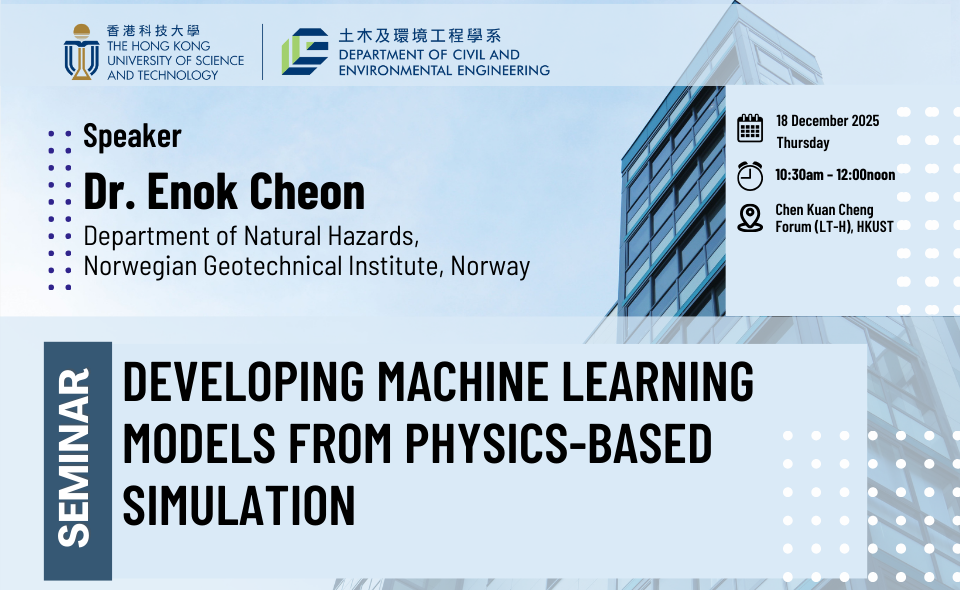
Civil Engineering Departmental Seminar - Developing Machine Learning Models from Physics-based Simulation
Supporting the below United Nations Sustainable Development Goals:支持以下聯合國可持續發展目標:支持以下联合国可持续发展目标:
Developing Machine Learning Models from Physics-based Simulation
The common approach in landslide hazard assessment either relies on physics-based simulation models or data-driven machine learning (ML) models. The former is well established and widely applicable, but is computationally expensive when applied to large-scale areas. The latter method can overcome computational limitations, but can be limited by the training data and challenging to explain how the developed ML model matches the expected physics. A combined approach in which the physics simulation generates datasets used to develop surrogate ML models. The combined approach can potentially achieve a generalized ML model that more quickly replicates the physics-based simulation results. The proposed approach was used to evaluate landslide susceptibility for solar power plants installed on hillsides, to digitize debris flow propagation, and to predict the debris flow-impacted area based on rheology and entrainment properties. The development process and approaches for verifying the ML model's explainability are presented.
Dr. Enok Cheon is a project engineer/researcher at the Norwegian Geotechnical Institute (NGI) in Oslo, Norway. He earned his MEng in Civil Engineering from University College London (UCL) and Ph.D. from KAIST (Korea Advanced Institute of Science and Technology). His research interests and specialities include simulating and optimizing mitigation design for landslide geohazards through numerical simulations, machine learning models, and algorithmic techniques. He also works on offshore site characterisation using a Bayesian statistical approach, developing combined simulation-and-ML-based methods for risk assessment of landslide-related geohazards, and creating software tools to perform developed models (e.g., 3DTS, SPEC-debris, etc.).