Atomic-Precision Materials for Electronics and Quantum Technologies:From Centimeter Crystals to Ångström Defects
Supporting the below United Nations Sustainable Development Goals:支持以下聯合國可持續發展目標:支持以下联合国可持续发展目标:
As electronic and quantum devices shrink toward the atomic scale, their performance is increasingly set by single defects, interfaces and contacts rather than by the bulk material. This talk describes how my group controls materials across seven orders of magnitude in length, from centimeter-scale crystals down to individual atoms.
At the largest scale, a transient-pressure flux method grows hexagonal boron nitride single crystals up to 6 mm across, with point-defect densities low enough to match the benchmark hBN used in today’s 2D devices. For transition-metal dichalcogenide monolayers, solid-phase chalcogenization produces chemical-vapor-deposited films as clean as exfoliated flakes, and growth under light and electrostatic gating offers a route to push defect densities lower still. At interfaces, semimetal contacts bring 2D transistors close to their intrinsic limits.
At the smallest scale, we couple light into an aberration-corrected electron microscope. The illumination heals beam damage as it forms, which lets us write and erase defects one atom at a time and opens a path to designed dopant lattices, quantum-emitter arrays and new correlated states. Machine-learning tools for atom-resolved metrology tie these scales into one loop of synthesis, measurement and devices.
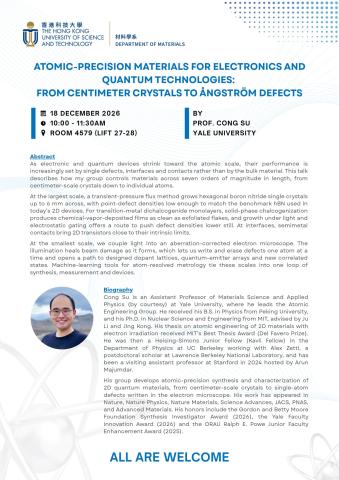
Cong Su is an Assistant Professor of Materials Science and Applied Physics (by courtesy) at Yale University, where he leads the Atomic Engineering Group. He received his B.S. in Physics from Peking University, and his Ph.D. in Nuclear Science and Engineering from MIT, advised by Ju Li and Jing Kong. His thesis on atomic engineering of 2D materials with electron irradiation received MIT’s Best Thesis Award (Del Favero Prize). He was then a Heising-Simons Junior Fellow (Kavli Fellow) in the Department of Physics at UC Berkeley working with Alex Zettl, a postdoctoral scholar at Lawrence Berkeley National Laboratory, and has been a visiting assistant professor at Stanford in 2024 hosted by Arun Majumdar.
His group develops atomic-precision synthesis and characterization of 2D quantum materials, from centimeter-scale crystals to single-atom defects written in the electron microscope. His work has appeared in Nature, Nature Physics, Nature Materials, Science Advances, JACS, PNAS, and Advanced Materials. His honors include the Gordon and Betty Moore Foundation Synthesis Investigator Award (2026), the Yale Faculty Innovation Award (2026) and the ORAU Ralph E. Powe Junior Faculty Enhancement Award (2025).