Social Science Seminar - Electric Vehicle Safety: The Effects of Weight and Technology
Supporting the below United Nations Sustainable Development Goals:支持以下聯合國可持續發展目標:支持以下联合国可持续发展目标:
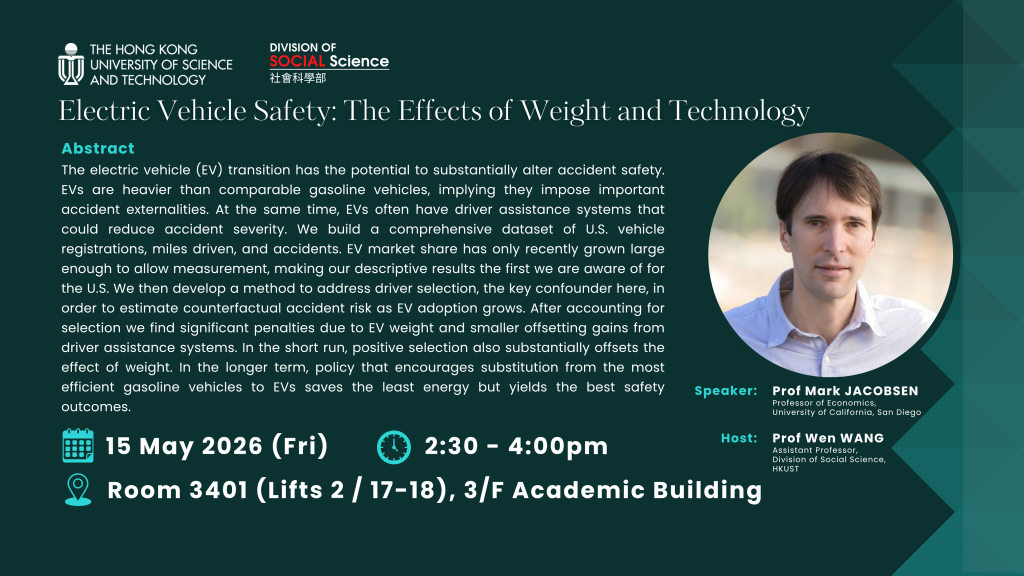
The electric vehicle (EV) transition has the potential to substantially alter accident safety. EVs are heavier than comparable gasoline vehicles, implying they impose important accident externalities. At the same time, EVs often have driver assistance systems that could reduce accident severity. We build a comprehensive dataset of U.S. vehicle registrations, miles driven, and accidents. EV market share has only recently grown large enough to allow measurement, making our descriptive results the first we are aware of for the U.S. We then develop a method to address driver selection, the key confounder here, in order to estimate counterfactual accident risk as EV adoption grows. After accounting for selection we find significant penalties due to EV weight and smaller offsetting gains from driver assistance systems. In the short run, positive selection also substantially offsets the effect of weight. In the longer term, policy that encourages substitution from the most efficient gasoline vehicles to EVs saves the least energy but yields the best safety outcomes.
Mark Jacobsen is a Professor of Economics at the University of California, San Diego and Research Associate at the National Bureau of Economic Research. He received his Ph.D. in economics from Stanford University. Jacobsen's research focuses on energy and environmental economics with emphasis on regulation in the transportation sector.
Host: Prof Wen WANG, Assistant Professor, Division of Social Science, HKUST