Social Science Seminar - Constrained Occupational Pathways: Historical Ethnic Penalties in Career Mobility among Japanese Immigrants in the United States, 1920–1940
Supporting the below United Nations Sustainable Development Goals:支持以下聯合國可持續發展目標:支持以下联合国可持续发展目标:
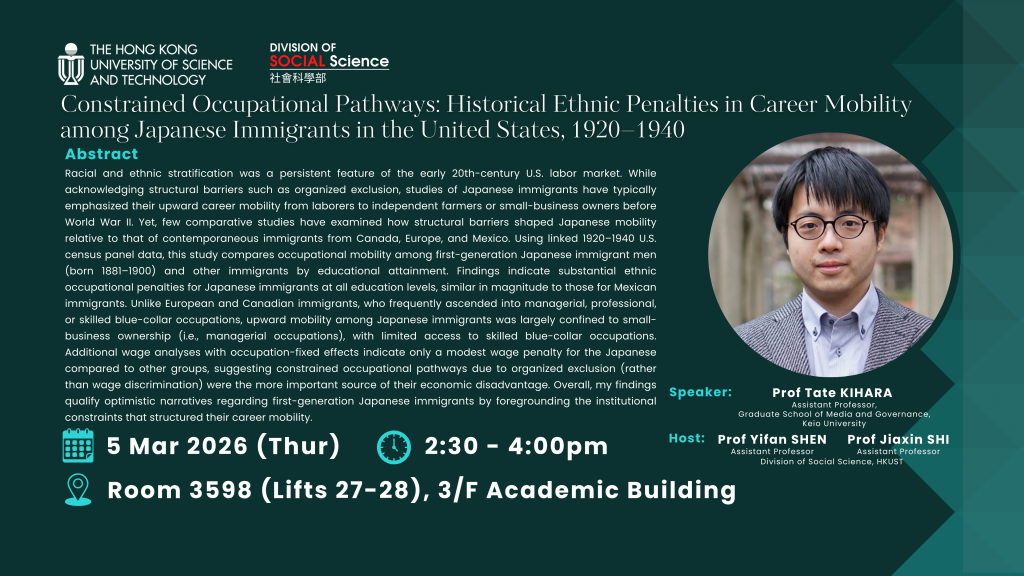
Racial and ethnic stratification was a persistent feature of the early 20th-century U.S. labor market. While acknowledging structural barriers such as organized exclusion, studies of Japanese immigrants have typically emphasized their upward career mobility from laborers to independent farmers or small-business owners before World War II. Yet, few comparative studies have examined how structural barriers shaped Japanese mobility relative to that of contemporaneous immigrants from Canada, Europe, and Mexico. Using linked 1920–1940 U.S. census panel data, this study compares occupational mobility among first-generation Japanese immigrant men (born 1881–1900) and other immigrants by educational attainment. Findings indicate substantial ethnic occupational penalties for Japanese immigrants at all education levels, similar in magnitude to those for Mexican immigrants. Unlike European and Canadian immigrants, who frequently ascended into managerial, professional, or skilled blue-collar occupations, upward mobility among Japanese immigrants was largely confined to small-business ownership (i.e., managerial occupations), with limited access to skilled blue-collar occupations. Additional wage analyses with occupation-fixed effects indicate only a modest wage penalty for the Japanese compared to other groups, suggesting constrained occupational pathways due to organized exclusion (rather than wage discrimination) were the more important source of their economic disadvantage. Overall, my findings qualify optimistic narratives regarding first-generation Japanese immigrants by foregrounding the institutional constraints that structured their career mobility.
Tate Kihara is an Assistant Professor in Graduate School of Media and Governance, Keio University. He is s a social demographer whose research examines international migration to and from Japan in both historical and contemporary contexts, with a focus on social inequality. His work has appeared in Demography, International Migration Review, and the Journal of Ethnic and Migration Studies.
Host: Prof Yifan SHEN, Assistant Professor, Division of Social Science, HKUST
Prof Jiaxin SHI, Assistant Professor, Division of Social Science, HKUST