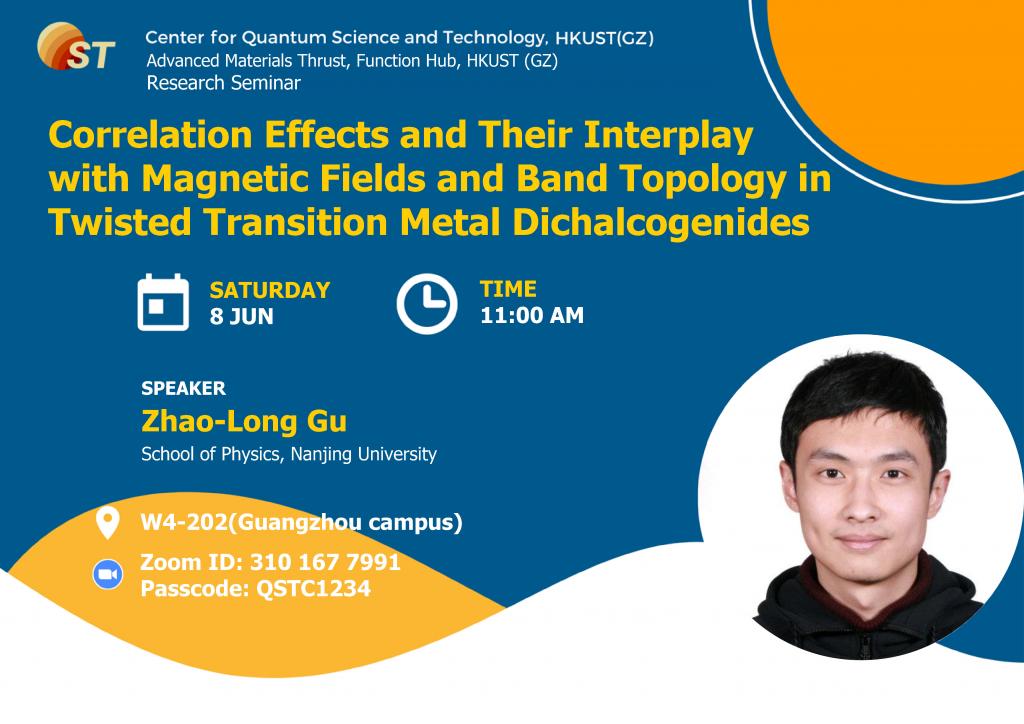
QST Seminar - Correlation Effects and Their Interplay with Magnetic Fields and Band Topology in Twisted Transition Metal Dichalcogenides
Supporting the below United Nations Sustainable Development Goals:支持以下聯合國可持續發展目標:支持以下联合国可持续发展目标:
Twisted transition metal dichalcogenides provide a new platform to explore strong correlation effects and their interplay with magnetic fields and band topology with high tunability. In this talk, I will introduce our recent works on twisted bilayer WSe2 (tWSe2) and MoTe2 (tMoTe2). (1) tWSe2 at 4°: Experiments have reported the Mott transition tuned by the displacement field and the strange metal behavior near the transition point. Using quantum cluster theory, we unveil that the ground state undergoes the bandwidth-controlled pseudogap-to-Mott-insulator-to-pseudogap-to-Fermi-liquid transitions solely tuned by the displacement field in the half-filled tWSe2, based on a comprehensive analysis of the band structures, Fermi surfaces, momentum distribution functions and quasiparticle weights in the presence of electron-electron interactions. The pseudogap phases are featured by isolated Fermi arcs or Fermi pockets coexisting with zeros of the single-particle Green’s function, and ascribed to the bridge states from the Mott insulator to the Fermi liquid. (2) tWSe2 at 3°: Our experimental collaborator, Professor Lei Wang from Nanjing University, has discovered recently that under magnetic fields, the system undergoes a Mott-insulator-to-metal-to-spin-polarized-insulator transition in the moderate interacting regime, while it undergoes a Mott-insulator-to-spin-polarized-insulator transition in the strong interacting regime. This experimental observation surpasses previous understanding of the evolution of Mott insulators under magnetic fields. Based on quantum cluster computations, we propose that this phenomenon is driven by a novel spectral weight transfer between spin-split upper and lower Hubbard bands induced by the magnetic field, providing new insights into Mott physics under magnetic fields. (3) tMoTe2: Experiments have discovered integer and fractional quantum Hall states in tMoTe2. Based on the exact diagonalization calculations on the ferromagnetic excitations and the topological properties of the magnon bands, we propose that the system can realize itinerant topological magnons. Unlike topological magnons in local spin systems, which result from spin-spin exchange interactions, such as the Dzyaloshinskii-Moriya interaction, the nontrivial topological properties of itinerant topological magnons originate from the nontrivial topology of the electronic bands. Furthermore, we pointed out that itinerant topological magnons can be experimentally detected through the thermal Hall conductance. This is the first theoretical prediction of itinerant topological magnons in real material systems.
Zhao-Long Gu is an associate researcher at the School of Physics, Nanjing University. He received his BSc in Physics from Nanjing University in 2012 and his PhD in Physics from the same institution in 2019. Since then, he has worked as an assistant/associate researcher in Jian-Xin Li's group at the School of Physics, Nanjing University. His research focuses on condensed matter theory, particularly strong correlation effects in electronic systems and their interplay with nontrivial band topology. His works have been published in prestigious journals, including Physical Review B, Nature Communications, and National Science Review.