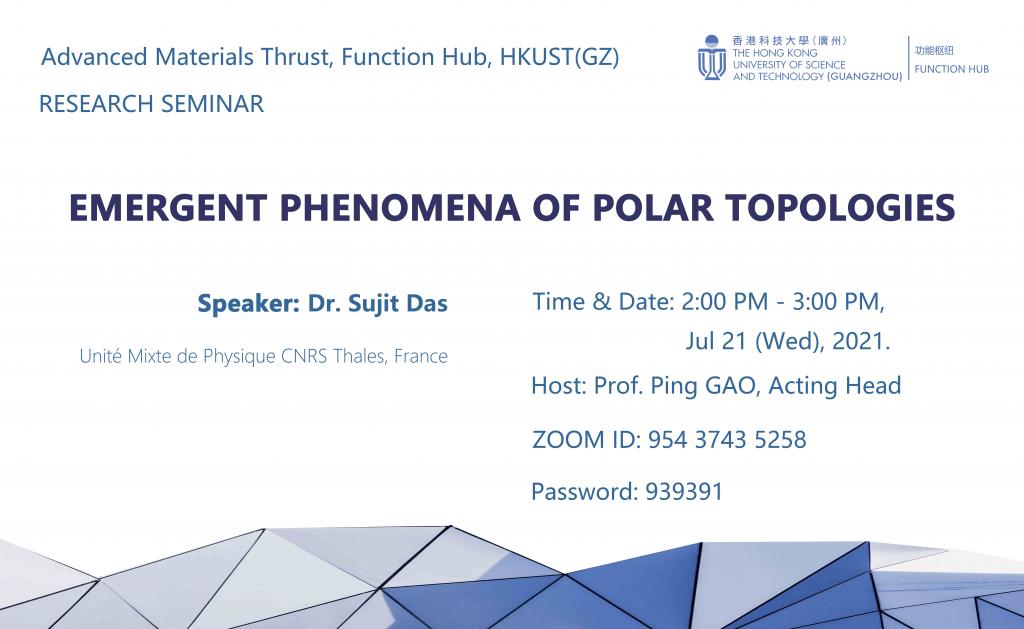
Public Research Seminar by Advanced Materials Thrust - Emergent Phenomena of Polar Topologies
Supporting the below United Nations Sustainable Development Goals:支持以下聯合國可持續發展目標:支持以下联合国可持续发展目标:
Complex topological configurations are a fertile arena to explore novel emergent phenomena and exotic phases in condensed-matter physics. The recent discovery of polarization vortices and the associated complex-phase coexistence and response under applied fields in ferroelectric oxide superlattices, has opened up new vistas to explore topology, emergent phenomena, and approaches for manipulating such features with electric fields1,2. Here, by varying epitaxial constraints we report the discovery of room-temperature polar skyrmions in a lead-titanate layer confined by strontium-titanate layers3. Phase-field modeling and second-principles calculations reveal that the polar skyrmions have a skyrmion number of +1, and resonant soft X-ray diffraction experiments show circular dichroism confirming chirality. Such nanometer-scale polar skyrmions are the electric analogs of magnetic skyrmions, and could advance ferroelectrics towards new levels of functionality.4-6 Using macroscopic dielectric measurements, we demonstrate that polar skyrmions in (PbTiO3)n/(SrTiO3)n superlattices are distinguished by a sheath of negative permittivity at the periphery of each skyrmion which enables a strong enhancement of the effective dielectric permittivity as compared to the individual SrTiO3 and PbTiO3 layers5,6 and phenomenon could be controlled by electric field and temperature. The production of such a steady-state negative capacitance and large field-tunable response has promise for high frequency electronic applications.6
1Yadav, A.K., Nelson, C.T. et al., Observation of polar vortices in oxide superlattices. Nature 530, 198-201 (2016).
2Damodaran, A., Clarkson, J., Hong, Z., Liu, H. et al., Phase coexistence and electric-field control of toroidal order in oxide superlattices. Nat. Mater. 16, 1003 (2017).
3 Das, S et al, Observation of room temperature polar skyrmions. Nature 568, 368-372 (2019).
4Li, Q., …., Das, S. et al, Collective excitations of polar vortices. Nature 592, 376-380 (2021)
5Yadav, A. K., …., Das, S. et al, Spatially Resolved Steady State Negative Capacitance. Nature 565, 468-471 (2019).
6Das, S. et al, Local negative permittivity and topological phase-transition in polar skyrmions. Nature Materials 20, 194 (2021)
Dr Sujit Das obtained his B.Sc in Physics from Calcutta University, India in 2009 and M.Sc in Physics from Indian Institute Technology Kanpur, India in 2011. He then pursued his Ph.D at The Leibniz Institute for Solid State and Materials Research in Dresden (IFW Dresden) and Martin Luther University (MLU) Halle-Wittenberg, Germany in Condensed Matter Physics/Material Science-Experiment under supervision of Professor Kathrin Dörr. His research focused on the magnetic order at coherent oxide interfaces. After he obtained his PhD in 2016, he continued his research career in the University of California, Berkeley, USA as a postdoctoral researcher in Professor Ramaoorthy Ramesh’s lab. His research areas focus on the synthesis of ferroic thin films, particularly on ferroelectric superlattices, ferroelectric quantum topological system by Laser MBE and characterization with different technique.