PPOL Divisional Seminar Series - AI and the Worlds of Collapse: Geographies of Loss, Continuity, and Emergence
Supporting the below United Nations Sustainable Development Goals:支持以下聯合國可持續發展目標:支持以下联合国可持续发展目标:
Dear Students and Colleagues,
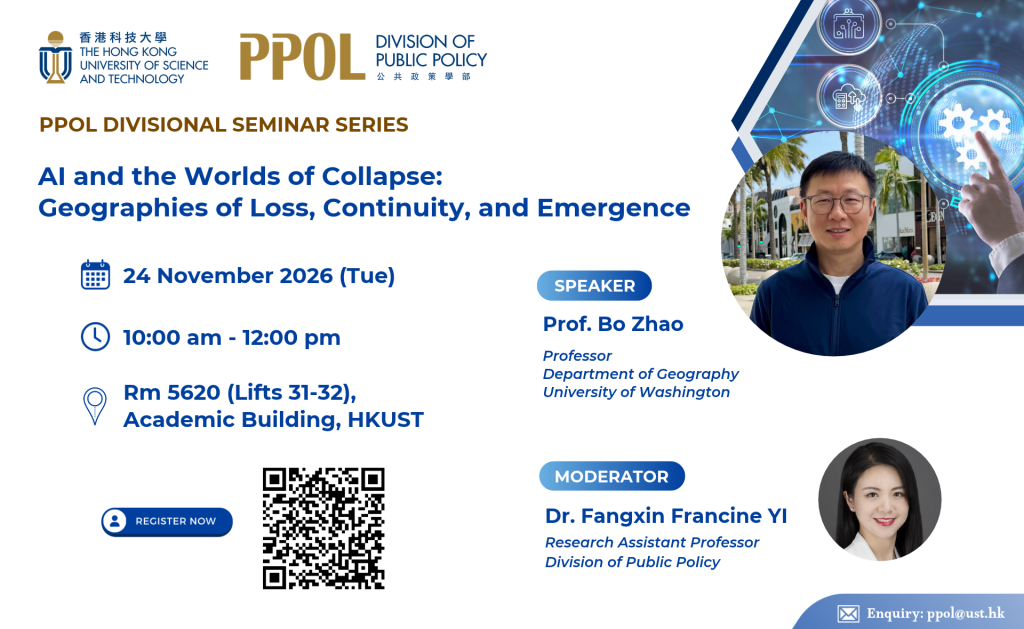
The Division of Public Policy (PPOL) cordially invites you to attend the seminar entitled "AI and the Worlds of Collapse: Geographies of Loss, Continuity, and Emergence". We are privileged to host Prof. Bo Zhao, Professor in the Department of Geography at the University of Washington and Director of the Humanistic GIS Laboratory, as our distinguished speaker for the talk.
Abstract:
As Artificial Intelligence (AI) increasingly mediates everyday life and the production of geographical knowledge, it reshapes how we experience, interpret, and engage with our surroundings. Drawing on the presenter’s recent publications, this seminar uses stellar collapse as a metaphor to examine these transformations, connecting large language models to their implications for personal experience and society. Through a series of analytical experiments with generative AI, including quantitative analyses of recursive synthetic data use and comparisons of AI-generated spatial representations, it examines how geographical characteristics are preserved, diminished, or reconfigured. Central to this inquiry is the loss of situatedness as AI-generated representations become detached from the geographical and social contexts that give them meaning. The experiments link changes in model performance and spatial representation to broader questions of geographical diversity and social inequality. Together, these discussions invite us to envision possible futures and consider alternative directions for AI development, with attention to their implications for personal experience and today’s society.
Bo Zhao is a Professor of Geography at the University of Washington and Director of the Humanistic GIS Laboratory. His research focuses on geographic information science, geospatial disinformation, and the societal impacts of emerging GIS technologies. He has gained recognition for his work on Humanistic GIS and Fake Geographies, critically examining how GIS shapes social structures, behaviors, and spatial cognition. Supported by organizations such as the NSF, NIH, and National Geographic Society, his research highlights the role of GIS in addressing issues of geoprivacy, security, and the spatial experiences of vulnerable communities.
Register now to join us via Qualtrics Survey on or before Monday, 23 November 2026, 4:00 pm. All are welcome!