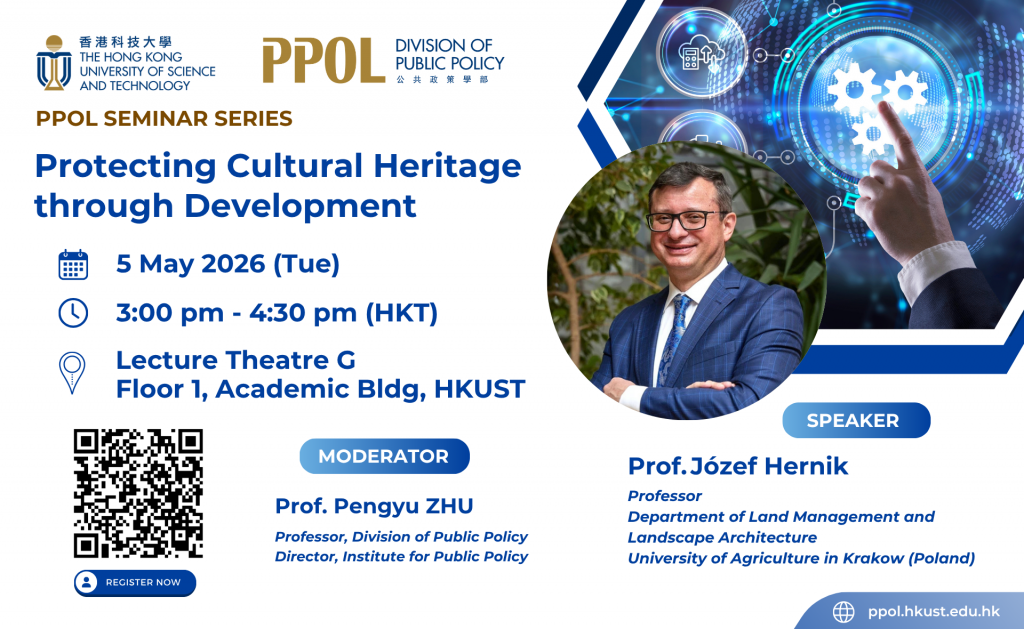
PPOL Divisional Seminar - Protecting Cultural Heritage through Development
Supporting the below United Nations Sustainable Development Goals:支持以下聯合國可持續發展目標:支持以下联合国可持续发展目标:
Abstract:
European countries have unique cultural landscapes that have developed gradually as a result of the interaction between people and the natural landscape. Their survival has been ensured through traditional land-use practices. Traditional forms of land use have ensured both continuity and a sustainable approach to land use, which generally benefits the landscape. Unfortunately, the rapid changes in both rural and urban environments – for example cities have been growing geometrically over the last few decades – have threatened many cultural landscapes.
There is a tendency to underestimate the cultural landscape, particularly at the local level. The protection of cultural landscapes often cannot compete with more urgent needs, both at the planning stage and during project implementation. Currently, municipalities that are located in areas with such valuable cultural landscapes may face challenges in managing them appropriately and responsibly. However, the existence of valuable cultural landscapes must not limit, prevent, or hinder the economic use of these areas, as it is essential to ensure that people living in these areas have the same opportunities as those who only visit these landscapes.
There is currently interest in Europe in the existing links between heritage landscapes and environmental development. In the landscape research, the following question is becoming increasingly relevant: what steps should be taken in the near future to implement the recommendations of the European Landscape Convention? In addition, efforts are being made to anticipate major environmental challenges, such as the transformation of agricultural policy, increasing urbanization, and climate and demographic changes.
Prof. dr hab. inż. Józef Hernik is a professor in the Department of Land Management and Landscape Architecture, Faculty of Environmental Engineering and Land Surveying, at the University of Agriculture in Krakow (Poland).
His main fields of interests and studies are cultural landscape, land use and environmental development. He also looks at the role of environmental policy, including risk mitigation and the role of climate change. He has been a project coordinator for five international research projects in the field cultural landscapes and land management. He is the author of more than 130 scientific publications and has been involved in scientific cooperation in the field of development and protection of cultural landscapes and land use with universities and research institutes in Europe, Americas and Asia.