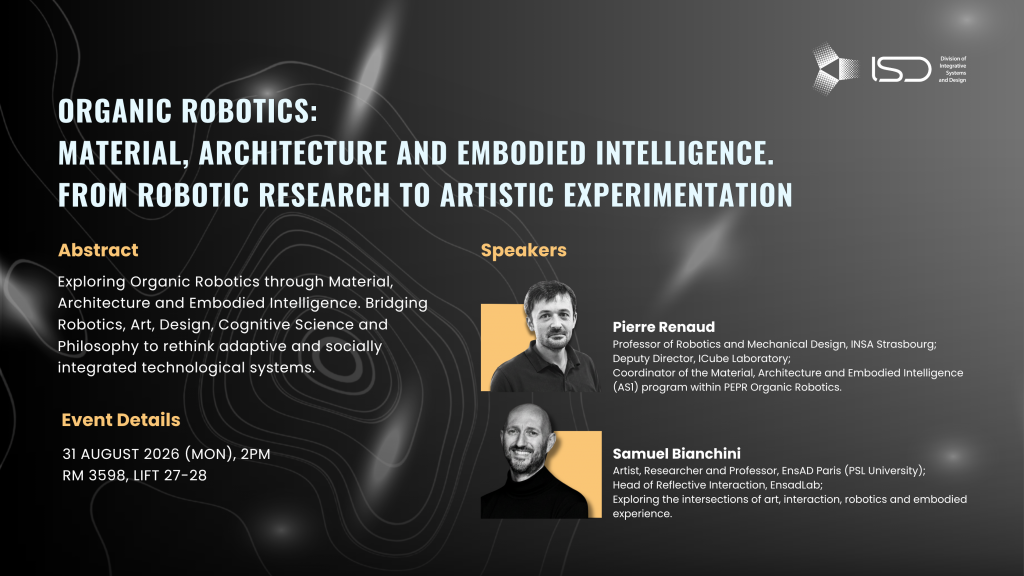
Organic Robotics: Material, Architecture and Embodied Intelligence. From Robotic Research to Artistic Experimentation
Supporting the below United Nations Sustainable Development Goals:支持以下聯合國可持續發展目標:支持以下联合国可持续发展目标:



For this lecture, Pierre Renaud and Samuel Bianchini will present research conducted within the framework of Organic Robotics, a French Priority Research Program and Equipment (PEPR), for which they serve as Principal Investigators.
The Organic Robotics Research Program aims to implement socially adapted robotics in terms of its principles, behavior, performance, and uses, and to address the complexity of societal challenges. This exploratory research program is based on a multidisciplinary approach integrating the social sciences and humanities, digital sciences, and engineering sciences. By integrating the contributions of these different disciplines, we will redefine methodologies, action and interaction behaviors, cognitive functions, and learning abilities, breaking with current robotic technologies and their limitations.
At a time when the ecological crisis is forcing us to take ever greater account of the different types of life that make up our environments, right down to matter itself, how can we design new forms of robotics that are better adapted to our environments and a vector of “acceptability” and even “desirability”? This is the main research question of the PEPR’s Structuring Action 1, untitled “Material, architecture and embodied intelligence,” led by Pierre Renaud. This Action proposes to address this issue through a hybrid approach from both hardware and disciplinary perspectives, involving engineering and informatics alongside anthropology, cognitive sciences, art and design, and philosophy.
In this multidisciplinary approach, Samuel Bianchini participates in this research program with an artistic approach that advocates for considering the aesthetic dimension of these robotic systems and for creating artworks-demonstrators. It is also with this intention to connect robotics research and artistic creation that he will publish (with Emanuele Quinz and with the support of the PEPR Organic Robotics) the book Behavioral Objects, Behavioral Matter - Rethinking Robotics Through Contemporary Art: An Atlas, which he will briefly present at this conference.
Prof. Pierre Renaud is a Full Professor at INSA Strasbourg and Deputy Director of the ICube laboratory, where he also serves as Head of Mission for valorization and research platforms. He is also the coordinator of the “Material, Architecture and Embodied Intelligence” axis (AS1) within the French national PEPR Organic Robotics (O2R) research program. His research focuses on robotics, mechatronics, and mechanical design, with particular emphasis on medical and surgical robotics. His work addresses the development of compliant and soft robotic systems, additive manufacturing, cable-driven mechanisms, and tensegrity structures. Professor Renaud has contributed to numerous projects involving robotic assistance for surgery, interventional radiology, and medical imaging. He was a Fulbright Fellow and Visiting Associate Professor at Stanford University in 2010–2011.
Prof. Samuel Bianchini is an artist and professor at École nationale supérieure des Arts Décoratifs (EnsAD, Paris Sciences et Lettres University) where he is the head of the Reflective Interaction group of EnsadLab (EnsAD’s laboratory). He is a member PEPR Organic Robotics, and he was Chair of the “ICRA-X: Robotics & Art Program” of the IEEE International Conference on Robotics and Automation (Icra) in 2020, and Cochair of the “Art & Performance Track” of the ACM International Conference on Tangible, Embedded and Embodied Interaction (TEI) in 2025. With more than 100 collective and 20 solo exhibitions, his works are regularly presented in Europe and around the world. In close relation to his research and artistic practice, Samuel Bianchini has undertaken theoretical work. He has published over 70 texts and 7 books, including the collective book Practicable. From Participation to Interaction in Contemporary Art, MIT Press, 2016 (co-directed with Erik Verhagen). He also founded the international and multi-platform image-based journal .able, of which he is currently editor-in-chief.