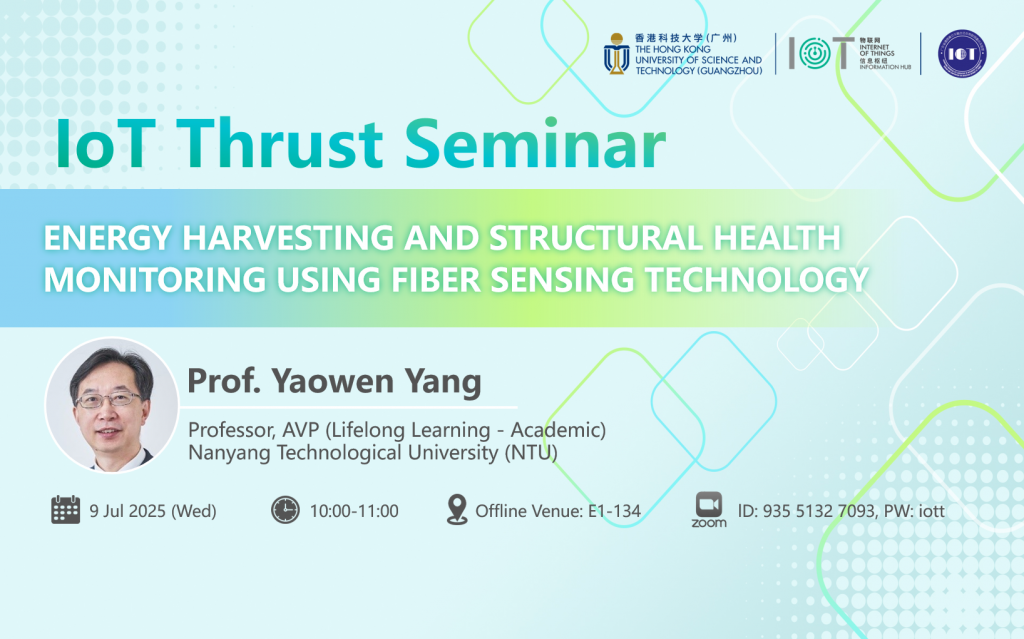
IoT Thrust Seminar | ENERGY HARVESTING AND STRUCTURAL HEALTH MONITORING USING FIBER SENSING TECHNOLOGY
Supporting the below United Nations Sustainable Development Goals:支持以下聯合國可持續發展目標:支持以下联合国可持续发展目标:
The world is marching into the era of the Internet of Things (IoT), comprising an enormous number of sensors and wearable electronics. The success of the IoT necessitates the need for renewable distributed energy sources. Usually, sensors are powered by traditional electrochemical batteries that have a limited lifetime and need regular replacement. The bulky batteries generate huge limitations for the miniaturization of electronic devices and cause pollution in the ambient environment. Energy harvesting technology, which converts ambient energy sources such as vibration and wind energy into electricity, provides a sustainable power source for IoT nodes. This talk provides an overview of the design, modeling, and experimental validation of cantilever-type triboelectric energy harvesters for generating electricity from vibration sources. By leveraging aerodynamic phenomena such as galloping and fluttering, these harvesters can also be optimized to extract energy from wind flows. Additionally, origami structures have gained significant attention in recent years due to their controllable flexibility, making them an ideal framework for integrating with flexible triboelectric materials. The discussion will also explore insights into the design of origami-inspired energy harvesters.
Critical infrastructures, such as buildings, tunnels, bridges and rails, need to be closely monitored to ensure their structural integrity during service life, especially for the cracks, corrosions and large joint deformations. Unlike traditional point-based sensors, which are limited to discrete locations, DFOS cables enable large-scale, kilometer-range monitoring with high sensitivity and spatial resolution for strain, temperature, and vibration measurements. Furthermore, DFOS offers excellent resistance to electromagnetic interference, as it relies on optical signals. This talk will introduce the practical applications of DFOS on the tunnel segment and rail track monitoring in Singapore.
Professor Yaowen Yang is currently of a professor in the School of Civil and Environmental Engineering, while also serving as the Associate Vice President (Lifelong Learning - Academic) in the President's Office, Nanyang Technological University (NTU), Singapore. He is also appointed as Changjiang Scholars Chair Professor. He stands as a lead researcher in the areas of energy harvesting and structural health monitoring. His research interests include aeroelastic and vibration energy harvesting, structural health and geotechnical monitoring, uncertainty analysis in structural dynamics, and metamaterials. Over the years, Prof. Yang has received more than $15M (Singapore dollar) research grant from funding agencies and industry, and published over 350 journal and conference papers. Prof. Yang's educational background includes a B.Eng and M.Eng from Shanghai Jiao Tong University, followed by a Ph.D. from Nanyang Technological University.
Beyond academia, Prof. Yang wears an entrepreneurial hat as well. He established a company aimed at implementing his patented technologies, thereby offering comprehensive solutions for geotechnical, structural, and construction process monitoring, culminating in informed decision-making. For his innovative research strides and entrepreneurial pursuits, Prof. Yang is designated as an iNTUitive Fellow, showcasing his distinguished contributions in translational research.