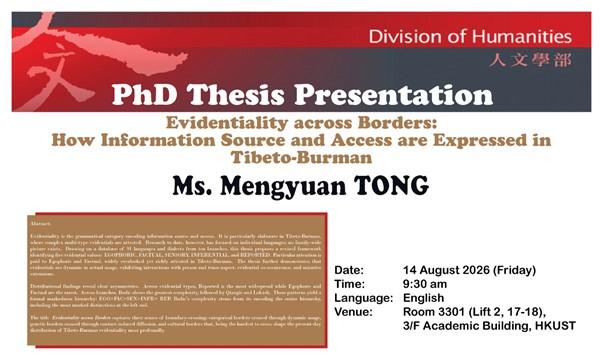
HUMA PhD Thesis Presentation - Evidentiality across Borders: How Information Source and Access are Expressed in Tibeto-Burman
Supporting the below United Nations Sustainable Development Goals:支持以下聯合國可持續發展目標:支持以下联合国可持续发展目标:
Abstract:
Evidentiality is the grammatical category encoding information source and access. It is particularly elaborate in Tibeto-Burman, where complex multi-type evidentials are attested. Research to date, however, has focused on individual languages; no family-wide picture exists. Drawing on a database of 91 languages and dialects from ten branches, this thesis proposes a revised framework identifying five evidential values: EGOPHORIC, FACTUAL, SENSORY, INFERENTIAL, and REPORTED. Particular attention is paid to Egophoric and Factual, widely overlooked yet richly attested in Tibeto-Burman. The thesis further demonstrates that evidentials are dynamic in actual usage, exhibiting interactions with person and tense-aspect, evidential co-occurrence, and mirative extensions.
Distributional findings reveal clear asymmetries. Across evidential types, Reported is the most widespread while Egophoric and Factual are the rarest. Across branches, Bodic shows the greatest complexity, followed by Qiangic and Loloish. These patterns yield a formal markedness hierarchy: EGO > FAC > SEN > INFR > REP. Bodic’s complexity stems from its encoding the entire hierarchy, including the most marked distinctions at the left end.
The title Evidentiality across Borders captures three senses of boundary-crossing: categorical borders crossed through dynamic usage, genetic borders crossed through contact-induced diffusion, and cultural borders that, being the hardest to cross, shape the present-day distribution of Tibeto-Burman evidentiality most profoundly.