FINTECH THRUST SEMINAR | How green is green? Anatomy of ESG funds’ selection
Supporting the below United Nations Sustainable Development Goals:支持以下聯合國可持續發展目標:支持以下联合国可持续发展目标:
We systematically anatomize ESG funds’ selection, by comparing them to an otherwise “optimal portfolio” benchmark rather than average non-ESG peers. We show that ESG funds “walk the talk” by selecting portfolios with a significant 36% less absolute emission, but with minimal outperformance in ESG scores and social measures: Over 90% of the emission reduction is achieved by excluding the 2% holdings of the top 25 highest-emitting companies, primarily at extensive margin; Excluding these top emitters, ESG funds fail to differ from their benchmarks. Perhaps surprisingly, ESG active funds select more by de-weighting the brownest industries whereas ESG index funds select more by de-weighting the brownest firms within each industry. As ESG funds tend to retain the primary components of the benchmark in their portfolios, the emission reduction is achieved without compromising risk profiles based on standard factors. However, ESG funds do not show significant differences in net-of-fee returns compared to their benchmarks, and demonstrate greater sensitivity to macroeconomic factors such as inflation and oil prices.
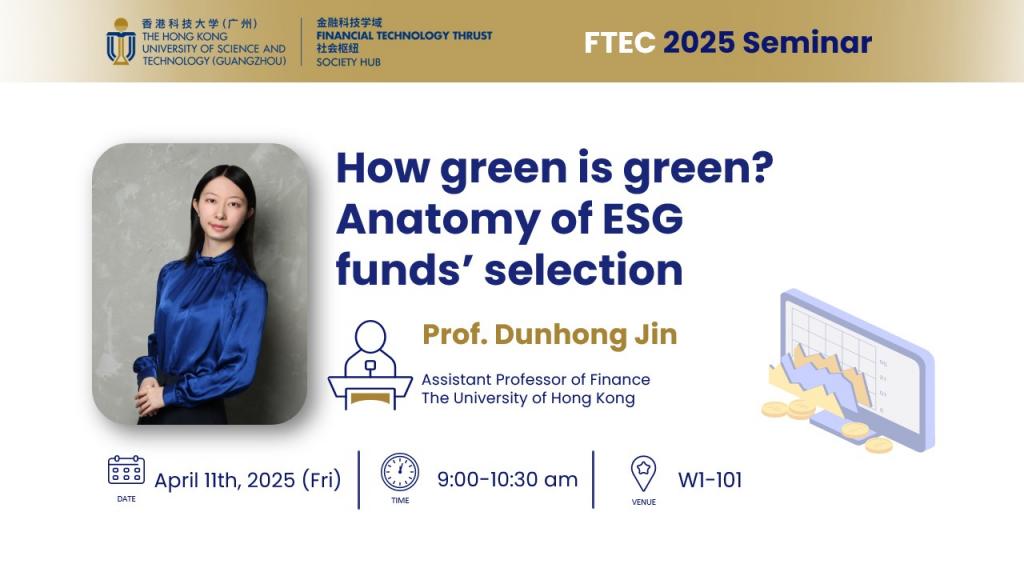
Dr. Dunhong Jin joined The University of Hong Kong as Assistant Professor of Finance in 2020. She received her Ph.D. in finance from University of Oxford. She obtained her M.Sc. in mathematical finance from University of Oxford, and her B.S. in mathematics from Fudan University. She is a theoretical financial economist, working on information, incentive and contract in asset management, corporate finance and asset pricing. She also has several joint projects with the Financial Conduct Authority on liquidity mismatch and financial stability in asset management industry.