Fintech Thrust Seminar | Demystifying High Frequency Trading
Supporting the below United Nations Sustainable Development Goals:支持以下聯合國可持續發展目標:支持以下联合国可持续发展目标:
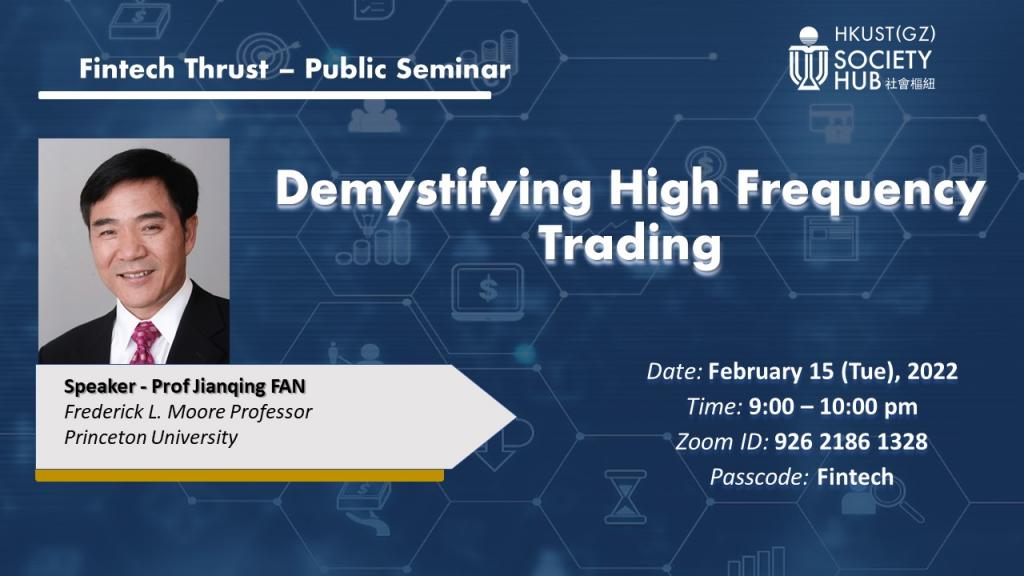
Demystifying High Frequency Trading
This paper studies the predictability in ultra high-frequency finance, with focus on the momentum measured by proportions of price changes and trade directions and duration that reflects trading speeds in very short time windows. These predictability issues are investigated by using three measures of time: calendar, trade and volume clocks. Using statistical machine learning methods on complete transaction and quote update data of $101$ stocks in the S&P 100 index over two full years from 2019 to 2020, we quantified and documented the predictability and confirmed that it exists universally. For a median stock, a 10.5% out-of-sample R^2 of 5-second trade returns can be predicted using merely past trade and quote data with about 64% of correctly predicting trade directions. For prediction of 10-trade duration, the median out-of-sample R^2 is 9.8%. The important predictors are also unveiled. We also investigated how the predictability depends on the market environments. Returns and directions are found more predictable for stocks that have smaller nominal share prices, that are less liquid, less volatile, and less related with the market. In contrast, predictability for durations are higher under liquid and volatile conditions. We also investigated the timeliness of data and found that predictability resides in the most recent 10 milliseconds, 10 transactions or 10 lots transacted, and decreases sharply once a small delay is introduced. We also simulate the possible ability of high-frequency traders in making short-term and imperfect predictions on future order flow. Such ability, even just correctly predict the sign, is able to boost 5-second return $R^2$ from 14.0% up to 27.1% and direction accuracy from 68.3% up to 79.0. Our study shed light on understanding micro-structure of price evolution and high-frequency finance. (Joint work with Yacine Air-Sahalia, Lirong Xue, and Yifeng Zhou)
Jianqing Fan is Frederick L. Moore Professor, Princeton University. After receiving his Ph.D. from the University of California at Berkeley, he has been appointed as professor at the University of North Carolina at Chapel Hill (1989-2003), the University of California at Los Angeles (1997-2000), and professor at the Princeton University (2003--). He was the past president of the Institute of Mathematical Statistics and International Chinese Statistical Association. He is co-editing Journal of Business and Economics Statistics and was the co-editor of The Annals of Statistics, Probability Theory and Related Fields, and Journal of Econometrics. His published work on statistics, economics, finance, and computational biology has been recognized by The 2000 COPSS Presidents' Award, The 2007 Morningside Gold Medal of Applied Mathematics, Guggenheim Fellow, P.L. Hsu Prize, Royal Statistical Society Guy medal in silver, Noether Senior Scholar Award, and election to Academician of Academia Sinica and follows of IMS, ASA, AAAS and SoFiE.