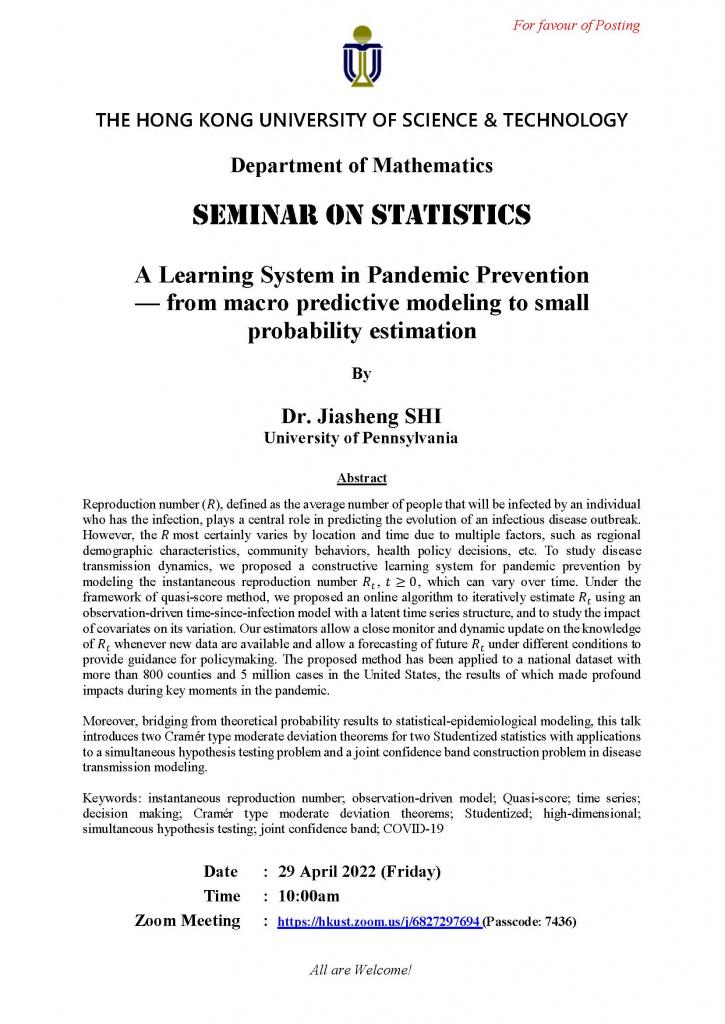
Department of Mathematics - Seminar on Statistics - A Learning System in Pandemic Prevention — from macro predictive modeling to small probability estimation
Supporting the below United Nations Sustainable Development Goals:支持以下聯合國可持續發展目標:支持以下联合国可持续发展目标:
Reproduction number (R), defined as the average number of people that will be infected by an individual who has the infection, plays a central role in predicting the evolution of an infectious disease outbreak. However, the R
most certainly varies by location and time due to multiple factors, such as regional demographic characteristics, community behaviors, health policy decisions, etc. To study disease transmission dynamics, we proposed a constructive learning system for pandemic prevention by modeling the instantaneous reproduction number Rt
, t≥0
, which can vary over time. Under the framework of quasi-score method, we proposed an online algorithm to iteratively estimate Rt
using an observation-driven time-since-infection model with a latent time series structure, and to study the impact of covariates on its variation. Our estimators allow a close monitor and dynamic update on the knowledge of Rt
whenever new data are available and allow a forecasting of future Rt
under different conditions to provide guidance for policymaking. The proposed method has been applied to a national dataset with more than 800 counties and 5 million cases in the United States, the results of which made profound impacts during key moments in the pandemic.
Moreover, bridging from theoretical probability results to statistical-epidemiological modeling, this talk introduces two Cramér type moderate deviation theorems for two Studentized statistics with applications to a simultaneous hypothesis testing problem and a joint confidence band construction problem in disease transmission modeling.
Keywords: instantaneous reproduction number; observation-driven model; Quasi-score; time series; decision making; Cramér type moderate deviation theorems; Studentized; high-dimensional; simultaneous hypothesis testing; joint confidence band; COVID-19