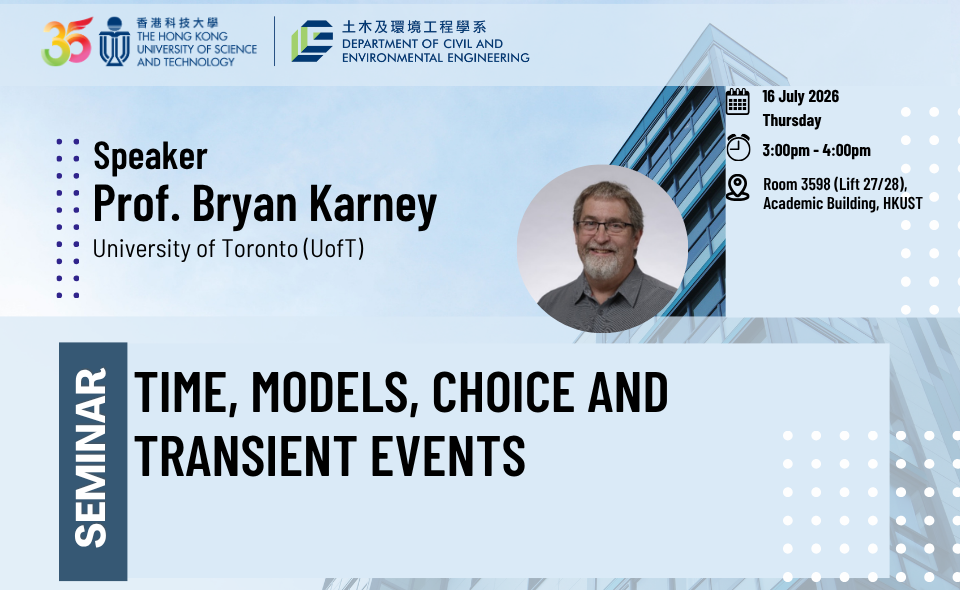
Civil Engineering Departmental Seminar - Time, models, choice and transient events
Supporting the below United Nations Sustainable Development Goals:支持以下聯合國可持續發展目標:支持以下联合国可持续发展目标:
The unachieved gold standard for water supply systems is for them to be durable, resilient, robust, long-lived, adaptable and economical. Many events threaten this ideal including extreme transient events – whether unusually high and/or low pressures and flows. But these same transient events – particularly when carefully controlled – present an opportunity to extract key system characteristics. This two-fold threat-opportunity nature often leads to notably different criteria for evaluating the performance and quality of simulation models. To deduce system characteristics the modeller is primarily concerned with accuracy and fidelity – does the model accurately capture the essential system attributes, attributes such as pipe and device parameters or faults such as leaks and blockages? The evaluation of threats and extreme events intrinsically puts the modeller in a different domain, one of risk management and the assessment of not only current conditions but what the future will bring. And the future is uncertain territory.
Traditionally, transient modellers face threats by attempting to be “fail-safe” in design, that is deducing worst case responses and trying to mitigate that reality. But that is not enough. Our water systems do fail and the challenge is thus to be “safe-fail” when designing protection strategies, a challenge with quite different modelling requirements. This talk will overview key alternatives to risk management and will distinguish between the modelling approaches required for assessing operational concerns with those associated with long-term capital investment and risk assessment. One approach is fail-safe; the other must be safe-fail.
Bryan Karney is a Professor of Civil Engineering at the University of Toronto (UofT), where he has taught since 1987. He holds a Ph.D. in Civil Engineering from the University of British Columbia and has almost 50 years of experience in hydraulic systems across water, wastewater, stormwater, oil, gas, and jet fuel domains. He is a Fellow of the American Association of the Advancement of Science. He served as Associate Dean of Engineering for 12 years at UofT. He is author and co-authors of a number of book and monographs including the “Comprehensive Water Distribution Systems Analysis Handbook for Engineers and Planners (2nd Ed.).” He is a co-founder of HydraTek, a leading consulting firm in water systems engineering. Bryan has published several hundred papers and co-authored several books. He has served as associate editor for journals including the Journals of Hydraulic Research and of Hydraulic Engineering, and received numerous awards for teaching and research. He has supervised over 25 Ph.D. and more than 100 master’s students. In administration, Dr. Karney led the launch of U of T’s Associate Dean Cross-Disciplinary Programs role, and helped to establish over a dozen engineering minors as popular options within the undergraduate program.