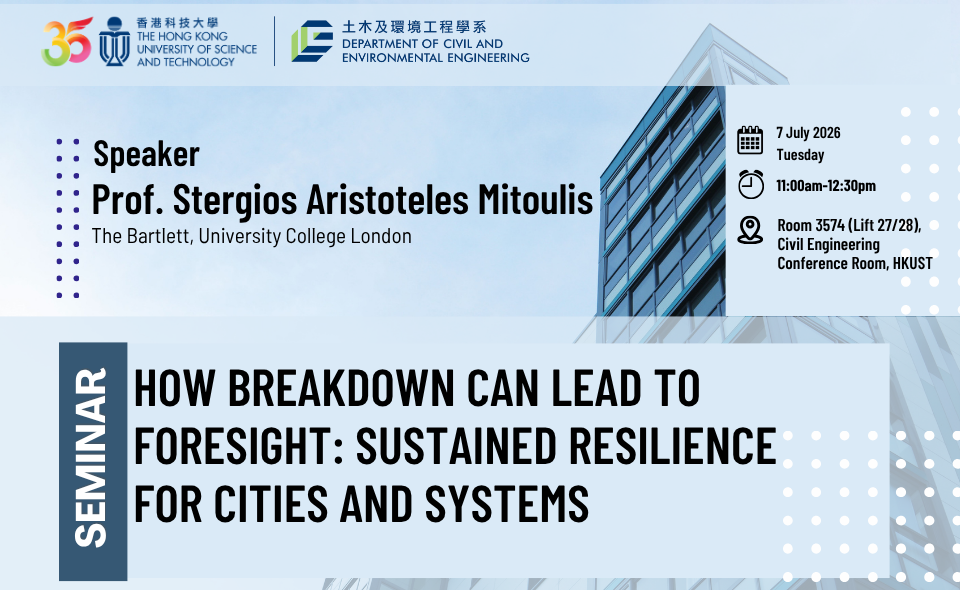
Civil Engineering Departmental Seminar - How breakdown can lead to foresight: Sustained resilience for cities and systems
Supporting the below United Nations Sustainable Development Goals:支持以下聯合國可持續發展目標:支持以下联合国可持续发展目标:
How breakdown can lead to foresight: Sustained resilience for cities and systems
Infrastructure and urban breakdowns are often treated as isolated failures, yet they can reveal the hidden interdependencies that shape the resilience of cities, economies, and societies. When a single asset fails, impacts can cascade across transport networks, supply chains, public services, labour markets, and regional economies. The collapse of the Francis Scott Key Bridge in Baltimore illustrates how one physical failure disrupted mobility, port operations, trade, employment, and wider economic activity, showing that breakdown can also become a source of foresight.
Here, we argue for embedding systemic and sustained resilience into infrastructure and urban design. Moving beyond component-level reliability and event-based recovery, this approach accounts for cascading disruptions while evaluating how functionality, environmental performance, economic viability, and social continuity evolve over time. Our results show that systemic resilience metrics can reduce cascading impacts, reveal overlooked intervention pathways, and help cities move from reactive recovery to anticipatory adaptation across lifecycles and urban epochs.
Prof Stergios Aristoteles Mitoulis is the Founding Director of the Centre of Global Infrastructure Resilience at the Bartlett, University College London, and Director of MetaInfrastructure.org and http://www.bridgeUkraine.org. He is Editor-in-Chief of the ICE Journal of Bridge Engineering and Founding Editor-in-Chief of Future Cities both published by Wiley & Sons. Trained as a bridge engineer, he has developed a fascination with people-centred systems, from cities to infrastructure networks. His broad, interdisciplinary research advances climate-resilient, sustainable, and digitally enabled infrastructure. At UCL he leads a multidisciplinary team of 35 researchers developing holistic, threat-agnostic frameworks for infrastructure adaptation to climate change and emerging risks. He has secured over £13 million (€15 million) in research funding across more than 50 projects, serving as coordinator and principal investigator on awards from UKRI, Horizon Europe, the British Academy, the Royal Society, UCL Grand Challenges, and charitable funders. He mentored more than 60 researchers, published 200+ papers, and contributed to standardisation through BSI and CEN. He is an active supporter of Ukraine’s infrastructure reconstruction and advises policymakers and media such as BBC, CNN and Sky News.