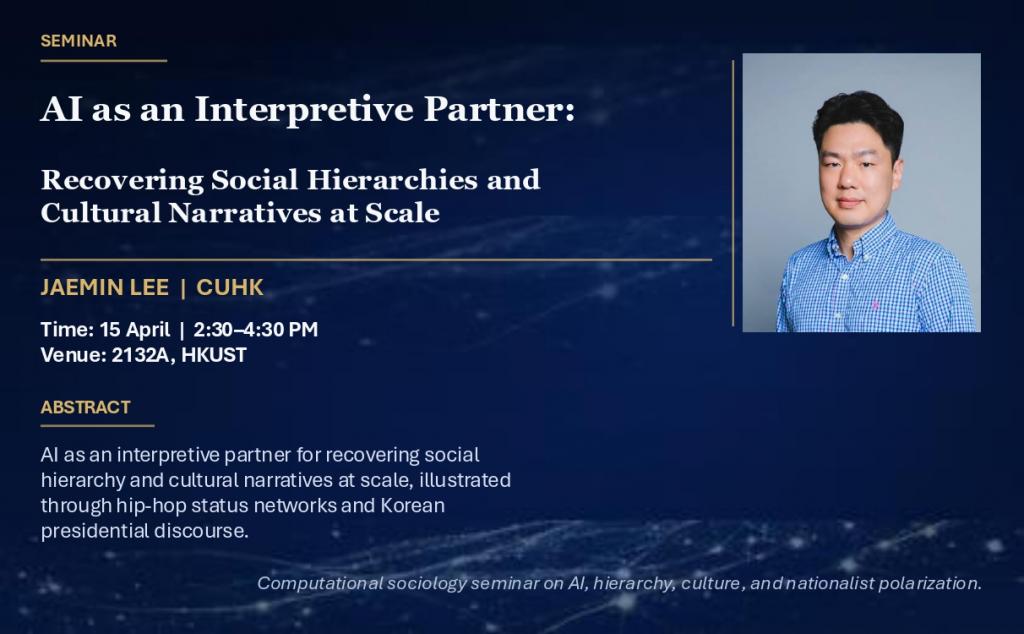
AI as an Interpretive Partner: Recovering Social Hierarchies and Cultural Narratives at Scale(只提供英文版本)
Supporting the below United Nations Sustainable Development Goals:支持以下聯合國可持續發展目標:支持以下联合国可持续发展目标:
(由于活动以英文为主,故只提供英文版本)
The rise of artificial intelligence has led to a wealth of new technologies and methods for social science research. This talk highlights how these tools can act as interpretive partners, expanding our ability to observe social hierarchies and cultural meaning structures that are only partially visible in conventional data. I illustrate these possibilities through two empirical applications. The first examines status dynamics in a hip‑hop "featuring" network, where supervised learning infers the field’s own logic of deference from a partially observed status hierarchy. This produces a scalable measure of preferential attachment that aligns with expert judgments and reveals how status shapes audience reception. The second application turns to political discourse and polarization. Using narrative‑structural extraction and AI‑assisted classification, I analyze how Korean presidents construct internal identity narratives and how these narratives relate to the country’s historical relationship with Japan. A sentence‑embedding–based Japan Framing Score captures whether Japan is cast as an external diplomatic counterpart or an internalized moral problem, revealing systematic partisan differences in how leaders coordinate identity and foreign‑relations narratives. Together, these cases demonstrate how AI can scale interpretation and open new avenues for theorizing status, culture, and nationalist polarization.
(由于活动以英文为主,故只提供英文版本)
Jaemin Lee is an Assistant Professor of Sociology and the Associate Director (Methods cluster) of the Centre for Population Research at The Chinese University of Hong Kong (CUHK). Before joining CUHK, he was a postdoctoral fellow at Northeastern University’s Network Science Institute. He holds a PhD in Sociology from Duke University.
Professor Lee is a computational sociologist who studies how social networks shape political, economic, and cultural behavior. His research uses network models and text analysis to identify the structural mechanisms—such as hierarchy, cohesion, peer influence, and boundary‑making—through which social systems both constrain and enable collective action. His work has appeared in Proceedings of the National Academy of Sciences, Sociological Methods & Research, Sociological Science, Socius, and the Journal of International Development, among others.