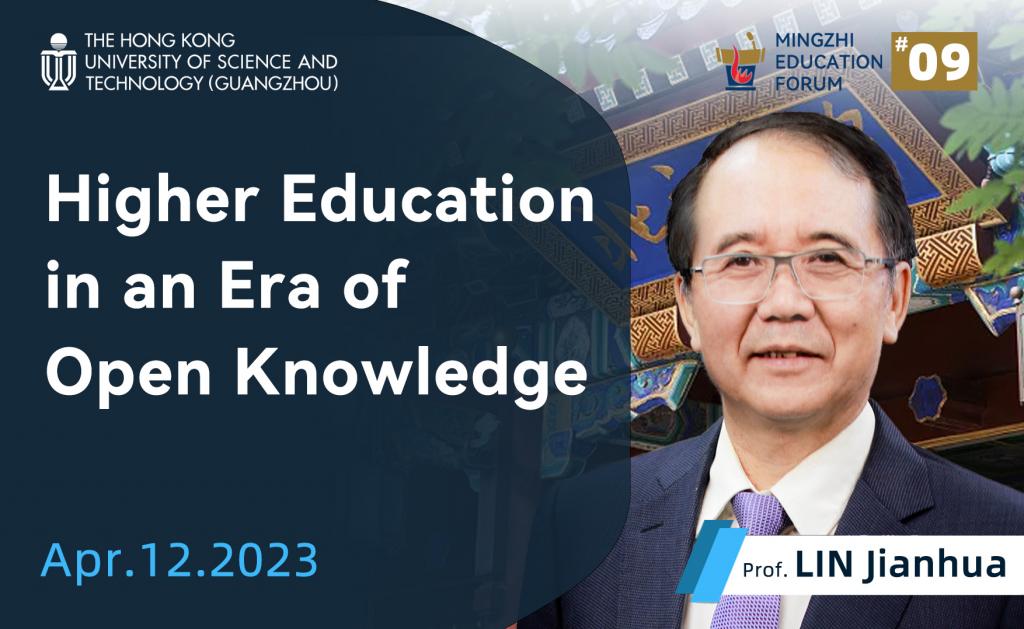
Mingzhi Education Forum #09 - Higher Education in an Era of Open Knowledge
Supporting the below United Nations Sustainable Development Goals:支持以下聯合國可持續發展目標:支持以下联合国可持续发展目标:
In today's knowledge society, knowledge has become the most important factor in production, determining a country's strength, social civilization, and economic development. For a significant period in the past, universities almost monopolized the creation, dissemination, and preservation of human knowledge. Although the application of knowledge mainly occurred outside schools, it was still based on scientific discoveries and talents cultivation by universities.
However, in the era of open knowledge, the way people learn and access information has changed. Enterprises have become the main force for technological innovation. Society contains rich and valuable educational and academic resources. Therefore, universities should not regard themselves as knowledge monopolizers, but should change their mindset and find ways to draw on and make good use of social resources to fully unleash their internal vitality, keep pace with the times, and truly build China's high-level higher education system.
We will briefly describe some basic expressions and characteristics of the open knowledge era, as well as the challenges that universities will face, and conduct preliminary discussions on some potential issues and coping strategies.
Professor LIN Jianhua is an inorganic solid-state chemist who has served as president of Chongqing University, Zhejiang University, and Peking University. He is currently the Director of Future Education Center at Peking University, focusing on the macro issues of China's higher education reform and development. These issues include the concept of university education in the era of open knowledge, the reform of general education and engineering education, the summary of the experience and rules of new educational models, the modern university governance system, the relationship between government, society, and universities, the impact of market competition and administrative directives on universities, the internal governance structure of universities, and the mechanism of technology transfer of universities.
Over the past few years, together with colleagues from the Future Education Center, Professor Lin has conducted research, exchanges, and summaries of relevant educational issues, provided valuable research reports for the Ministry of Education, local governments, and social organizations, and published articles and delivered lectures on these topics.
Mingzhi Education Forum
"Mingzhi Education Forum" is hosted by the Institute of Education Innovation and Practice, the Vice President of Teaching and Learning Office, Hong Kong University of Science and Technology (Guangzhou), VPTLO-IEIP, HKUST(GZ). It is an integral part of a series of teacher training activities. Based on the needs of HKUST (GZ) for educational innovation, we will invite scholars and practitioners in related fields to be guest speakers at this Forum to share thoughts, insights, challenges, problems, and discuss solutions together. Relevant fields include but are not limited to innovation in teaching and learning, higher education assessment and evaluation, learning science, curriculum and pedagogy, cognitive psychology, brain science, neuroscience, education big data, higher education internationalization, and higher education policy.
English support
This lecture will be conducted in Mandarin. For English support, please follow the attached Operation Manual to download iTourVideo Translation, a tool to help you with English subtitles.
https://hkust.zoom.us/j/94820590364?pwd=MHpkbWVUUnUvdXdBNWpDeTZRRmN0QT09
Zoom ID:948 2059 0364
Password:815845