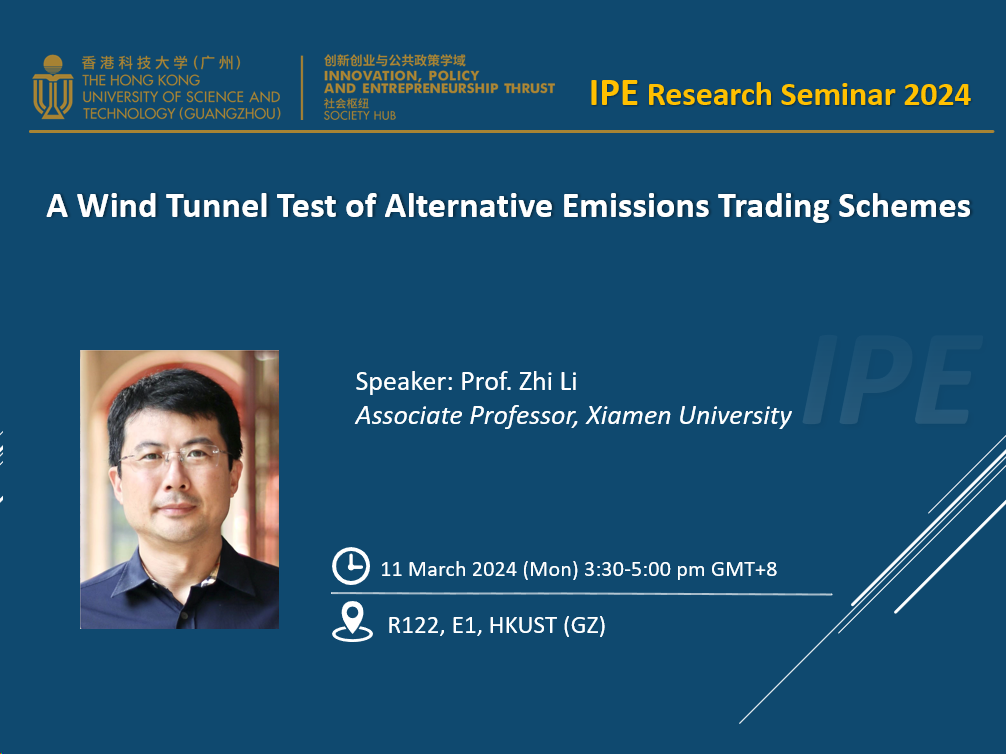
A Wind Tunnel Test of Alternative Emissions Trading Schemes
Supporting the below United Nations Sustainable Development Goals:支持以下聯合國可持續發展目標:支持以下联合国可持续发展目标:
With a unique opportunity of recruiting hundreds of emissions trading system (ETS) participants in a series of lab-in-the-field experiments, we compare a revenue-neutral consignment auction (CA) with free allocation (grandfathering, GF hereafter) and a uniform price auction (UPA) as alternative permit allocation designs. In our setup, firms first receive their permits for free. Then, under the two auction mechanisms, they need to buy back a share of the permits, either with auction revenues returned to the firms in the primary market (CA) or not returned (UPA), followed by a spot (secondary) market for all mechanisms with the continuous double auction. We find that enforced permit transactions in the primary market induce a higher price, facilitating price discovery with lower volatility and more effective trading in the spot market. Both auctions reduce non-compliance compared with GF, because the auctions reduce both permit hoarding and risky over-selling in the spot market. Both CA and UPA help smaller polluting firms lower their profit risks. CA also helps large, cleaner firms increase profits. Our results provide insights on permit allocation designs when introducing an ETS, especially for developing countries that are pondering the balance between market efficiency and firms’ cost burden.
Zhi Li is an associate professor at Department of Public Finance, School of Economics and the Wang Yanan Institutes for Studies in Economics, Xiamen University. He obtained Ph.D in Economics from University of Washington (Seattle). He uses game theory and economic experiments to design and test novel economic mechanisms with applications in public economics and resource and environmental economics. Currently, he is focusing on the design of voluntary provision mechanisms for local and global public goods, environmental markets for carbon allowances and credits, and water markets. His research has been published in Journal of Public Economics, Journal of Environmental Economics and Management, Journal of Public Economic Theory, Environmental and Resource Economics, PLOS ONE, etc. He is an associate editor for Resource and Energy Economics, and a committee member of China Emissions Trading Association (CETA) in the Chinese Society for Environmental Sciences (CSES).