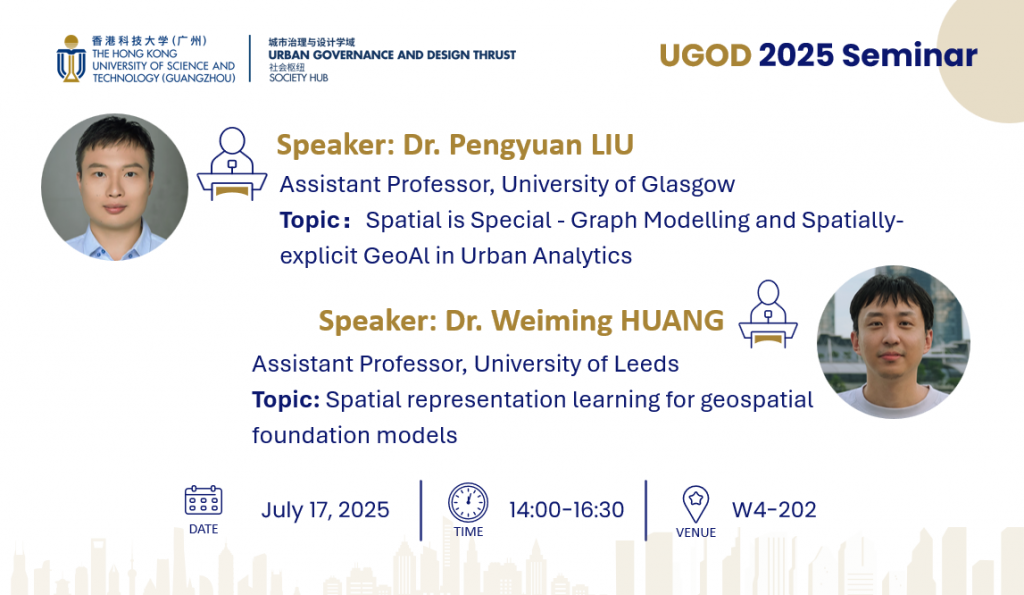
UGOD Seminar | Topic 1: Spatial is Special - Graph Modelling and Spatially-explicit GeoAl in Urban Ana; Topic 2: Spatial representation learning for geospatial foundation models
Supporting the below United Nations Sustainable Development Goals:支持以下聯合國可持續發展目標:支持以下联合国可持续发展目标:
Topic 1: Spatial is Special - Graph Modelling and Spatially-explicit GeoAl in Urban Analytics
Abstract: In an era of urban big data, understanding the spatial structure and dynamics of cities demands tools that are both computationally powerful and geographically grounded. This presentation explores how graph modelling and spatially-explicit Geospatial Artificial Intelligence (GeoAI) offer transformative potential in urban analytics. Emphasising that “spatial is special,” I demonstrate how geographic priors, such as spatial contiguity, proximity, and heterogeneity, can be explicitly integrated into machine learning pipelines through Graph Neural Networks (GNNs). By embedding urban data within graph structures that reflect the underlying spatial logic of cities, we enable more interpretable, scalable, and policy-relevant analysis. The talk bridges technical methods with real-world urban challenges, showcasing how GNN-based models informed by geographic theory can advance our understanding of urban systems, from socio-spatial inequality to infrastructure resilience.
Topic 2: Spatial representation learning for geospatial foundation models
Abstract: The rise of large-scale pre-trained models, also known as foundation models, has sparked great interest within the geospatial and urban communities. This trend naturally leads to two fundamental questions: 1) can general-purpose foundation models be directly applied to geospatial analyses? 2) given the transformative impact of large-scale pre-training in fields like natural language processing and computer vision, can we develop foundation models to benefit geospatial tasks?
In this presentation, I will share our recent explorations toward answering these questions. I will begin by exploring the application of various foundation models to a wide range of geospatial and urban analyses. Taking a step further, we view learning effective representations from multi-modal geospatial data as the cornerstone of developing geospatial foundation models. To this end, I will present our progress in spatial representation learning across a wide range of geospatial data sources, gradually leading to our recent work on developing geospatial foundation models, including an early version of City Foundation Models (CityFM).
Dr Pengyuan Liu is currently working as a Lecturer (Assistant Professor) in Digital Planning at the University of Glasgow. His expertise lies in the field of quantitative urban geography, with a specialisation in GeoAI and urban digital twin research. He holds a PhD in Geography from the University of Leicester, UK.
Before joining the University of Glasgow, he served as a Senior Postdoctoral Researcher and Coordinator at the Future Cities Laboratory, Singapore-ETH Centre. In 2023, he also contributed as a Lecturer in Human Geography and Urban Planning at Nanjing University of Information Science and Technology. His academic journey includes valuable postdoctoral research experiences at the NUS Urban Analytics Lab and the University of Helsinki.
Dr Liu is passionate about integrating Geospatial Analytics, Artificial Intelligence, and Digital Twins into urban studies. His research focuses on developing theories, algorithms, and models to advance this integration. He is also a strong advocate for open data initiatives in academia, demonstrated by his role in organising international academic conferences for OpenStreetMap, including the 2022 State of the Map (Academic Track) and 2023 OSMScience. His work aims to foster innovation in urban studies through cutting-edge research and collaboration, contributing to the development of smarter, more sustainable urban environments.
Weiming Huang is a Lecturer (Assistant Professor) in Urban Data Science at the University of Leeds, UK. He obtained his PhD in Geographical Information Science from Lund University, Sweden, and was a Wallenberg Postdoctoral Fellow at Nanyang Technological University and Lund University. He is the recipient of several prestigious awards, including the EuroSDR Award for the Best PhD Thesis Related to Geoinformation Science in 2021 and the Waldo Tobler Young Researcher Award from the Austrian Academy of Sciences in 2022. His research interests include spatial data mining and more recently geospatial foundation models. He has acted as a guest editor for leading GIScience journals such as IJGIS, TGIS, and JAG, and served on the program committee of top-tier machine learning conferences including ICLR, NeurIPS, and ICML.