UGOD Seminar | Rapid Disaster Response based on GeoAI and Cross-View Imagery
Supporting the below United Nations Sustainable Development Goals:支持以下聯合國可持續發展目標:支持以下联合国可持续发展目标:
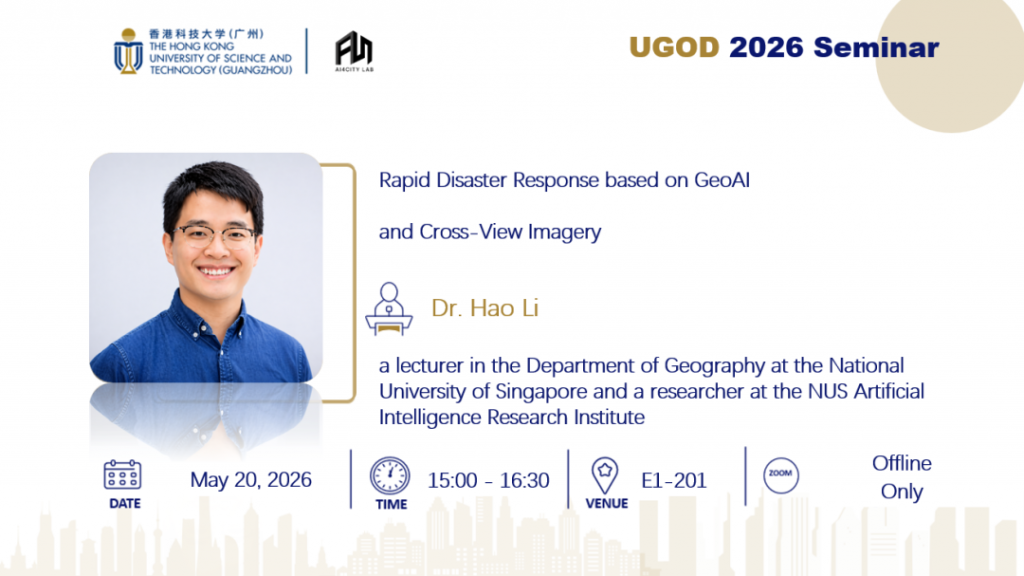
Extreme climate events and natural disasters play an important role in shaping the interaction between humans and urban infrastructure. In this talk, we introduce a series of novel disaster mapping methods aimed at addressing two major issues: geolocation and damage perception estimation, through cross-view street-level imagery and ultra-high-resolution satellite imagery. The first CVDisaster framework comprises two cross-view models: the first is a cross-view geolocation model based on contrastive learning objectives, utilizing a twin-structure image encoder; the second is a cross-view classification model based on a coupled global context visual Transformer. Taking Hurricane IAN as a case study, we constructed a new cross-view dataset, CVIAN, and conducted extensive experiments to evaluate the performance of the framework, providing significant insights for future cross-view models and their applications in the broader GeoAI research community.
Dr. Hao Li currently works as a lecturer in the Department of Geography at the National University of Singapore and a researcher at the NUS Artificial Intelligence Research Institute, primarily focusing on Geographic Information Science (GIScience) and GeoAI research. He obtained his PhD from Heidelberg University in Germany and previously worked as a postdoctoral researcher at the Technical University of Munich. His research interests include multimodal spatiotemporal intelligent perception, spatial representation learning, disaster response, volunteer geographic information (VGI) quality assessment and utilization, as well as spatial computing methods for sustainable and resilient cities. To date, he has published over 50 peer-reviewed papers in top journals and conferences, including RSE, ISPRS P&RS, IJGIS, CEUS, ES&T, and ACM SIGSPATIAL. He also serves as the secretary of the ISPRS WG IV/6 working group and has chaired several workshops, served on project committees, and served as a guest editor for journals.