UGOD Seminar | Breaking ethnic boundaries: The evolution of interethnic marriages in China, 1982–2010
Supporting the below United Nations Sustainable Development Goals:支持以下聯合國可持續發展目標:支持以下联合国可持续发展目标:
In multiethnic societies, interethnic marriage serves as a critical lens for understanding cultural integration and status hierarchies. Using data from China’s Censuses (1982–2010), we examine how these dynamics unfold in a context where ethnic disparities intersect with state-led preferential policies. Although uncommon, intermarriage with the Han majority gradually increased, occurring most frequently among the Manchu, Mongolian, and Southern minorities, and least frequently among the Kazakh and Uyghur. After controlling for ethnic compositions, most groups exhibited increasing boundary permeability over time, with the notable exception of the Manchu. Our analysis of educational patterns reveals two distinct mechanisms for boundary crossing: educational assortative mating among relatively assimilated groups (e.g., Hui, Manchu, Mongolian), and status exchange for less assimilated groups. Notably, Tibetan and Southern minorities, who benefit most from preferential state policies, tended to marry Han spouses with higher education than those they would marry in endogamous marriages, suggesting a “reversed” pattern of exchange. These findings reveal that marriage choices reflect complex negotiations between cultural preservation, status sorting, and state-structured incentives, providing insights into the persistence and malleability of ethnic boundaries in contemporary societies.
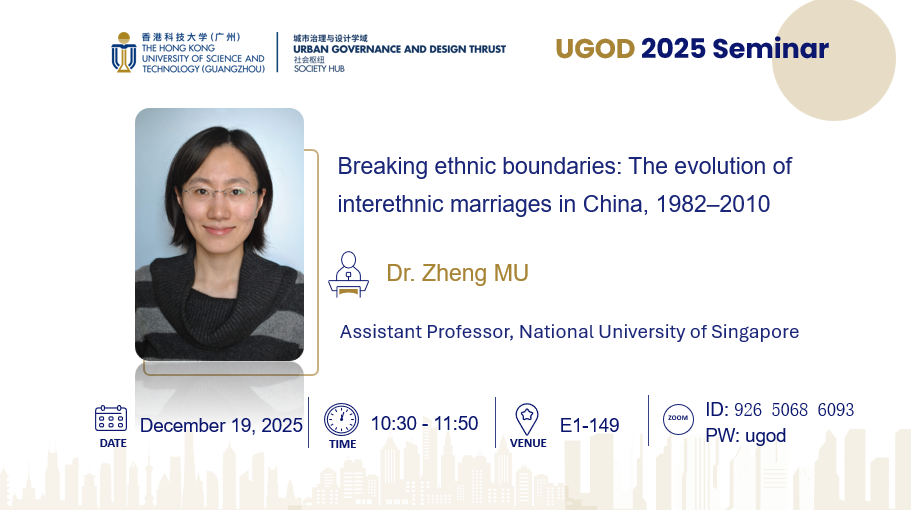
Dr. Zheng Mu is Assistant Professor at the Department of Sociology and Anthropology, National University of Singapore. Her general research interests focus on trends, social determinants, and consequences of marriage and family behaviors, with a focus on how marriage and family have served as inequality-generating mechanisms. Her ongoing research projects examine how internal migration, ethnic identification, interactions between gender and intergenerational inequality, and interactions between ideational and socioeconomic contexts shape individuals' time use patterns, family experiences, and well-being in China and Singapore.