Social Science Seminar - The Illusion of Foreign Capital: Estimating Round-Trip FDI in China using Firm-level Data
Supporting the below United Nations Sustainable Development Goals:支持以下聯合國可持續發展目標:支持以下联合国可持续发展目标:
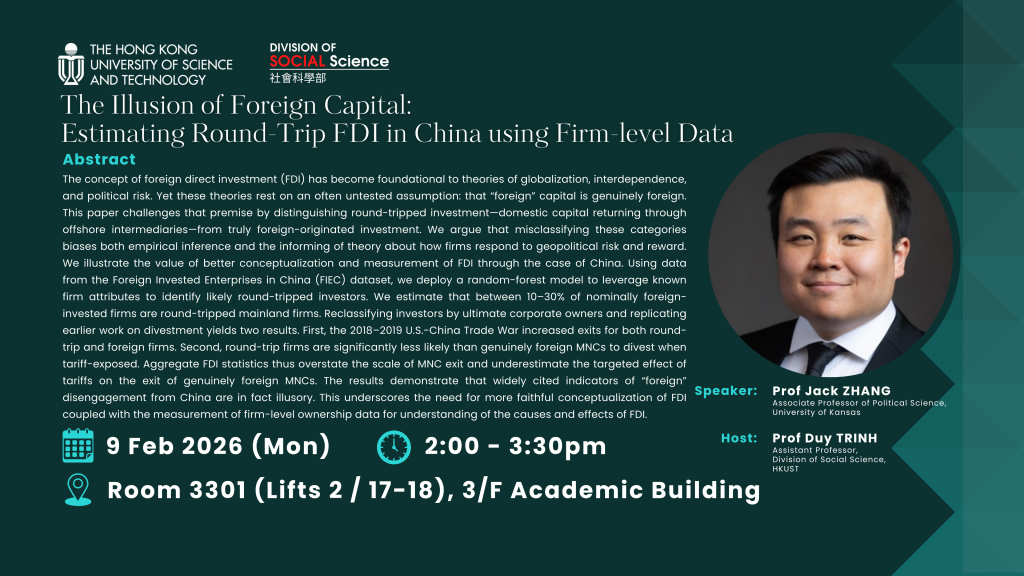
The concept of foreign direct investment (FDI) has become foundational to theories of globalization, interdependence, and political risk. Yet these theories rest on an often untested assumption: that “foreign” capital is genuinely foreign. This paper challenges that premise by distinguishing round-tripped investment—domestic capital returning through offshore intermediaries—from truly foreign-originated investment. We argue that misclassifying these categories biases both empirical inference and the informing of theory about how firms respond to geopolitical risk and reward. We illustrate the value of better conceptualization and measurement of FDI through the case of China. Using data from the Foreign Invested Enterprises in China (FIEC) dataset, we deploy a random-forest model to leverage known firm attributes to identify likely round-tripped investors. We estimate that between 10–30% of nominally foreign-invested firms are round-tripped mainland firms. Reclassifying investors by ultimate corporate owners and replicating earlier work on divestment yields two results. First, the 2018–2019 U.S.-China Trade War increased exits for both round-trip and foreign firms. Second, round-trip firms are significantly less likely than genuinely foreign MNCs to divest when tariff-exposed. Aggregate FDI statistics thus overstate the scale of MNC exit and underestimate the targeted effect of tariffs on the exit of genuinely foreign MNCs. The results demonstrate that widely cited indicators of “foreign” disengagement from China are in fact illusory. This underscores the need for more faithful conceptualization of FDI coupled with the measurement of firm-level ownership data for understanding of the causes and effects of FDI.
Jack Zhang is Associate Professor of Political Science at the University of Kansas (KU) where he also serves as the Associate Director for the Center for East Asian Studies and the Director of the Trade War Lab. He is a Public Intellectual Fellow with the National Committee on U.S.-China Relations and was a Wilson China Fellow at the Wilson Center in 2021-2022 and a postdoctoral research fellow at the Niehaus Center for Globalization and Governance at Princeton University in 2018-2019. His research and teaching interests include international political economy, international security, foreign policy analysis, Chinese foreign policy, and U.S.-China relations. He has published extensively in leading academic journals and his work has featured in prominent media outlets such as The Washington Post, The Wall Street Journal, Foreign Policy, SCMP, and NPR. Dr. Zhang received his Ph.D. from the University of California San Diego (UCSD) and his BA from Duke University.
Host: Prof Duy TRINH, Assistant Professor, Division of Social Science, HKUST