Social Science Seminar - High Returns, Low Adoption: Air Purifiers in Bangladeshi Firms
Supporting the below United Nations Sustainable Development Goals:支持以下聯合國可持續發展目標:支持以下联合国可持续发展目标:
Authors: Teevrat Garg (UC San Diego), Maulik Jagnani (Tufts) and Nancy Lozano-Gracia (World Bank)
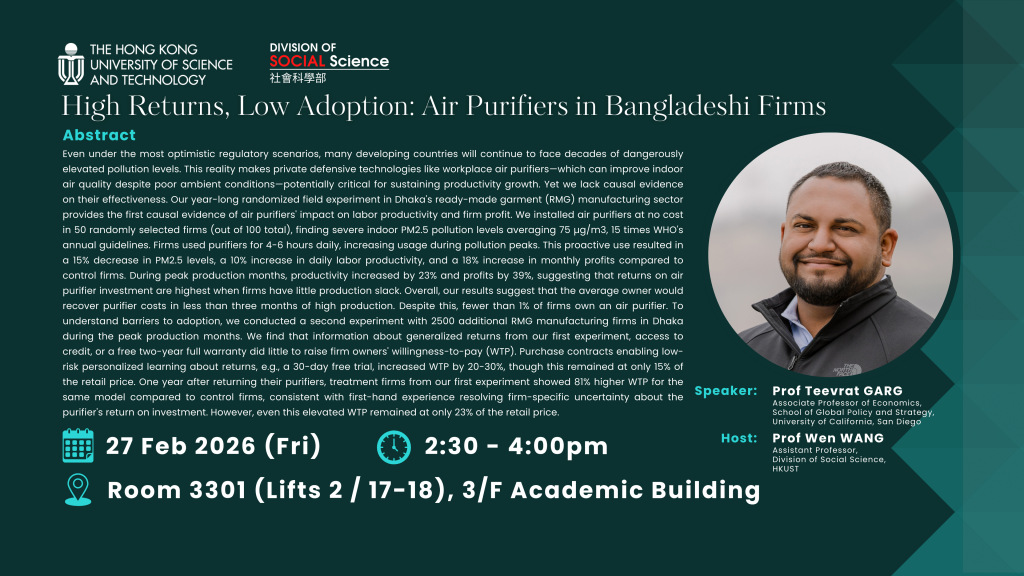
Even under the most optimistic regulatory scenarios, many developing countries will continue to face decades of dangerously elevated pollution levels. This reality makes private defensive technologies like workplace air purifiers—which can improve indoor air quality despite poor ambient conditions—potentially critical for sustaining productivity growth. Yet we lack causal evidence on their effectiveness. Our year-long randomized field experiment in Dhaka's ready-made garment (RMG) manufacturing sector provides the first causal evidence of air purifiers' impact on labor productivity and firm profit. We installed air purifiers at no cost in 50 randomly selected firms (out of 100 total), finding severe indoor PM2.5 pollution levels averaging 75 µg/m3, 15 times WHO's annual guidelines. Firms used purifiers for 4-6 hours daily, increasing usage during pollution peaks. This proactive use resulted in a 15% decrease in PM2.5 levels, a 10% increase in daily labor productivity, and a 18% increase in monthly profits compared to control firms. During peak production months, productivity increased by 23% and profits by 39%, suggesting that returns on air purifier investment are highest when firms have little production slack. Overall, our results suggest that the average owner would recover purifier costs in less than three months of high production. Despite this, fewer than 1% of firms own an air purifier. To understand barriers to adoption, we conducted a second experiment with 2500 additional RMG manufacturing firms in Dhaka during the peak production months. We find that information about generalized returns from our first experiment, access to credit, or a free two-year full warranty did little to raise firm owners' willingness-to-pay (WTP). Purchase contracts enabling low-risk personalized learning about returns, e.g., a 30-day free trial, increased WTP by 20-30%, though this remained at only 15% of the retail price. One year after returning their purifiers, treatment firms from our first experiment showed 81% higher WTP for the same model compared to control firms, consistent with first-hand experience resolving firm-specific uncertainty about the purifier's return on investment. However, even this elevated WTP remained at only 23% of the retail price.
Teevrat Garg is an Associate Professor of Economics at the School of Global Policy and Strategy at the University of California, San Diego. His research focuses on decarbonization, energy transitions, air quality, and climate adaptation. His work combines rigorous empirical methods with close partnerships with governments, utilities, and NGOs to generate evidence that informs real-world policy. His scholarship has been published in leading economics journals such as the American Economic Journal: Applied Economics, American Economic Journal: Economic Policy, Review of Economics and Statistics, and the Economic Journal, as well as interdisciplinary outlets including Nature, Science, Nature Communications, and Nature Sustainability. His research has been featured in prominent media outlets including The New York Times. He holds affiliations with major research networks such as J-PAL, IGC and CESifo and previously served on the Board of Directors of the Association of Environmental and Resource Economists. He is an editor at the Journal of the Association of Environmental and Resource Economists. He has contributed to flagship policy assessments, including serving as a Technical Contributor to the Economics chapter of the Fifth U.S. National Climate Assessment and as co-lead author of the economic impacts report for California’s Fifth Climate Assessment.
In addition to his academic work, he is a co-founder of Pow-dr Technologies, a company developing scalable demand-side energy solutions designed to expand grid flexibility in emerging markets.
Host: Prof Wen WANG, Assistant Professor, Division of Social Science, HKUST