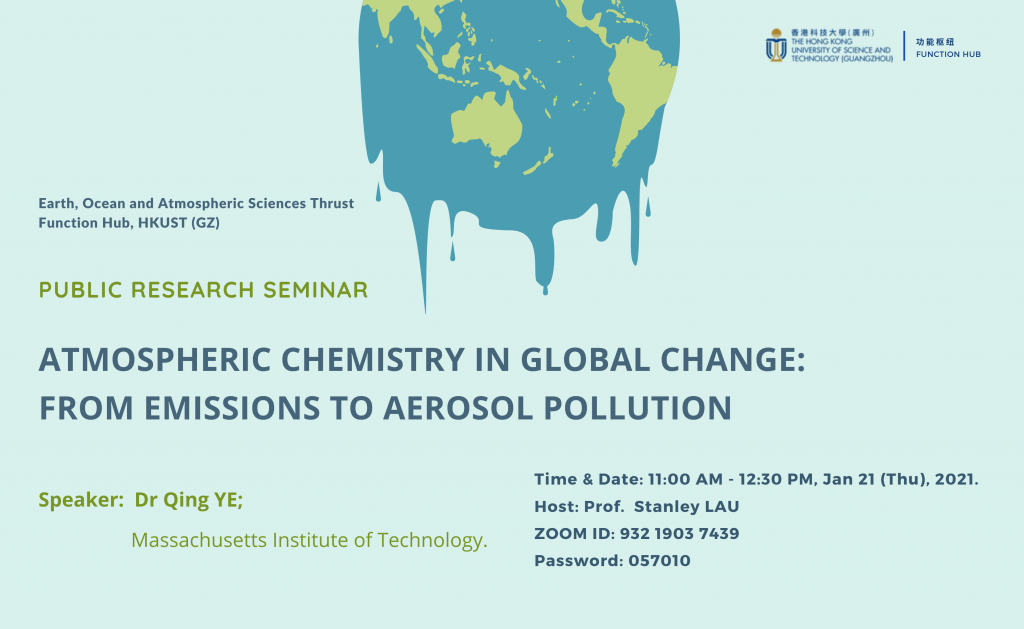
Research Seminar by Earth, Ocean and Atmospheric Sciences Thrust, Function Hub, HKUST (GZ) - Atmospheric Chemistry in Global Change: from Emissions to Aerosol Pollution
Supporting the below United Nations Sustainable Development Goals:支持以下聯合國可持續發展目標:支持以下联合国可持续发展目标:
Atmospheric aerosols, solid or liquid particulate matter in the air, play a pivotal role in cloud formation and precipitation, and represent the major source of uncertainty in accounting for changes to Earth's energy balance due to human activities. In addition, aerosol pollution is one of the major environmental health risks globally, and is responsible for millions of premature death worldwide.
Due to the variety of sources and chemistry, atmospheric aerosols comprise myriad compounds with a wide range of volatilities and structures that determine aerosols’ gas-particle partitioning, chemical reactivities, and interactions with human body.
In addition, due to further atmospheric aging, the properties and composition of aerosol vary across different spatial and temporal scales. The research described in this seminar aims to advance our understanding of the detailed physiochemical processes of atmospheric aerosols and their human exposure through advanced experimental approaches, novel field measurements, and state-of-the-art analytical techniques.
Dr. Qing Ye is currently a postdoctoral associate in the department of Civil and Environmental Engineering at the Massachusetts Institute of Technology. She received her joint PhD degree in Chemistry and Engineering and Public Policy from Carnegie Mellon University in 2019. Her academic interests are at the intersection of atmospheric chemistry, its role in air pollution, and climate change. Dr. Qing Ye was an awardee of the Faculty for the Future Fellowship, and received the Young Investigators Lecturer from California Institute of Technology.