Public Research Seminar by Sustainable Energy and Environment Thrust, Function Hub, HKUST(GZ) - Valorization of Sustainable and Waste Feedstock for Energy and Environmental Sustainability
Supporting the below United Nations Sustainable Development Goals:支持以下聯合國可持續發展目標:支持以下联合国可持续发展目标:
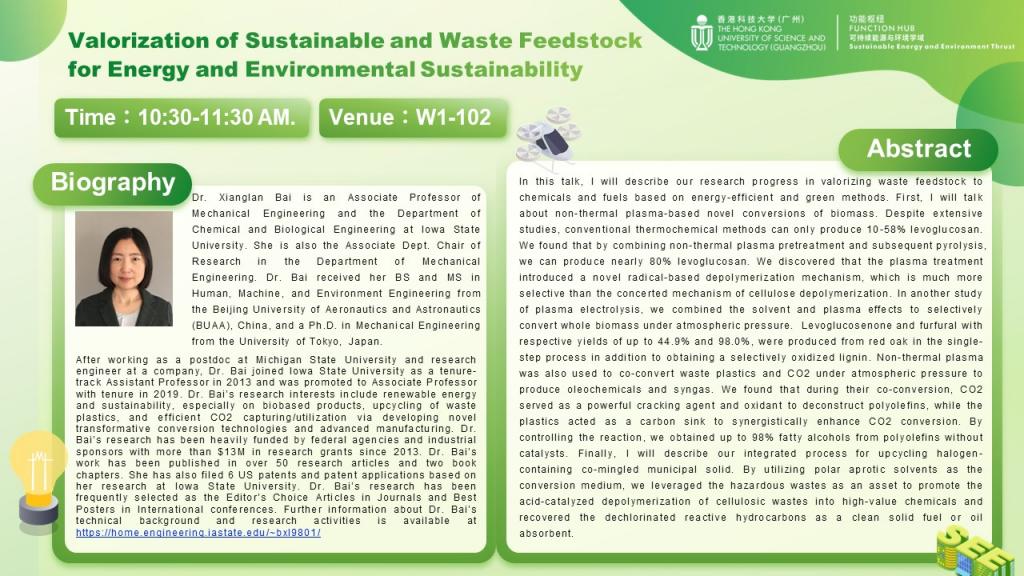
In this talk, I will describe our research progress in valorizing waste feedstock to chemicals and fuels based on energy-efficient and green methods. First, I will talk about non-thermal plasma-based novel conversions of biomass. Despite extensive studies, conventional thermochemical methods can only produce 10-58% levoglucosan. We found that by combining non-thermal plasma pretreatment and subsequent pyrolysis, we can produce nearly 80% levoglucosan. We discovered that the plasma treatment introduced a novel radical-based depolymerization mechanism, which is much more selective than the concerted mechanism of cellulose depolymerization. In another study of plasma electrolysis, we combined the solvent and plasma effects to selectively convert whole biomass under atmospheric pressure. Levoglucosenone and furfural with respective yields of up to 44.9% and 98.0%, were produced from red oak in the single-step process in addition to obtaining a selectively oxidized lignin. Non-thermal plasma was also used to co-convert waste plastics and CO2 under atmospheric pressure to produce oleochemicals and syngas. We found that during their co-conversion, CO2 served as a powerful cracking agent and oxidant to deconstruct polyolefins, while the plastics acted as a carbon sink to synergistically enhance CO2 conversion. By controlling the reaction, we obtained up to 98% fatty alcohols from polyolefins without catalysts. Finally, I will describe our integrated process for upcycling halogen-containing co-mingled municipal solid. By utilizing polar aprotic solvents as the conversion medium, we leveraged the hazardous wastes as an asset to promote the acid-catalyzed depolymerization of cellulosic wastes into high-value chemicals and recovered the dechlorinated reactive hydrocarbons as a clean solid fuel or oil absorbent.
Dr. Xianglan Bai is an Associate Professor of Mechanical Engineering and the Department of Chemical and Biological Engineering at Iowa State University. She is also the Associate Dept. Chair of Research in the Department of Mechanical Engineering. Dr. Bai received her BS and MS in Human, Machine, and Environment Engineering from the Beijing University of Aeronautics and Astronautics (BUAA), China, and a Ph.D. in Mechanical Engineering from the University of Tokyo, Japan. After working as a postdoc at Michigan State University and research engineer at a company, Dr. Bai joined Iowa State University as a tenure-track Assistant Professor in 2013 and was promoted to Associate Professor with tenure in 2019. Dr. Bai’s research interests include renewable energy and sustainability, especially on biobased products, upcycling of waste plastics, and efficient CO2 capturing/utilization via developing novel transformative conversion technologies and advanced manufacturing. Dr. Bai’s research has been heavily funded by federal agencies and industrial sponsors with more than $13M in research grants since 2013. Dr. Bai’s work has been published in over 50 research articles and two book chapters. She has also filed 6 US patents and patent applications based on her research at Iowa State University. Dr. Bai’s research has been frequently selected as the Editor’s Choice Articles in Journals and Best Posters in International conferences. Further information about Dr. Bai’s technical background and research activities is available at https://home.engineering.iastate.edu/~bxl9801/.
For inquiries, please contact Miss Suggi WU (+86-20-88332966, suggilswu@hkust-gz.edu.cn)