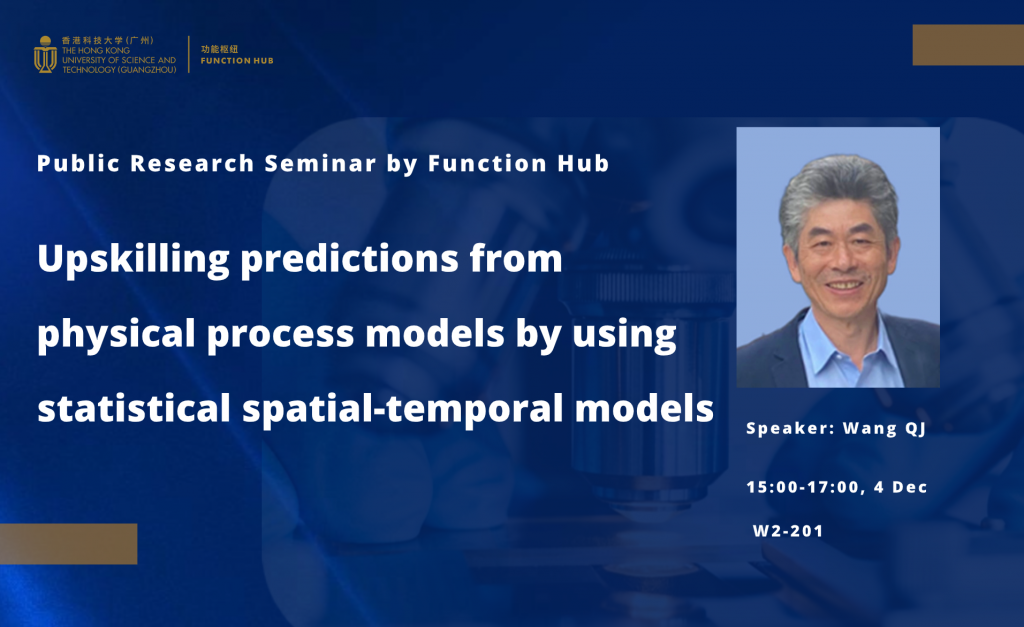
Public Research Seminar by Function Hub - Upskilling predictions from physical process models by using statistical spatial-temporal models
Supporting the below United Nations Sustainable Development Goals:支持以下聯合國可持續發展目標:支持以下联合国可持续发展目标:
Many environmental models have been developed based on physical processes and become highly valuable for environmental predictions. However, these models can be subject to errors, and improvements to the predictions may be needed for practical applications. Statistical post-processing of model outputs is a cost-effective way to produce more accurate predictions. In this talk, I will introduce a recently developed method to post-process dimensionally high spatial-temporal model outputs by combining empirical orthogonal function (EOF) analysis and regression. The EOF analysis is to reduce the high-dimensional spatial-temporal data to time series of a small number of reduced variables. These reduced variables then become the target for improvement through statistical calibration. Finally, a reverse application of the EOF analysis to the improved predictions of the reduced variables leads to post-processed, and expectantly improved, predictions of the original high-dimensional variables in a spatial field.
I will demonstrate the effectiveness of the method through two applications. One application is to improve precipitation forecasts from numerical weather prediction models. With our new method, we post-process forecasts for all grid-cells in a large field at once, directly embedding spatial structures in the produced ensembles. This method contrasts with the commonly used approach of post-processing grid-cell by grid-cell, followed by spatially connecting the ensemble members of individual grid-cells - a problem yet to be satisfactorily resolved.
A second application is to improve flood inundation simulations of low-fidelity hydrodynamic models. The use of low-fidelity models is to reduce model run time for real-time deployment, as high-fidelity hydrodynamic models are generally computationally too intensive, especially for ensemble runs. However, low-fidelity model simulations need to be made more accurate before use. With our new method, we post-process simulations from the low-fidelity models to accurately emulate high-fidelity hydrodynamic models, while in total using only a fraction of the time needed to run the latter. It then becomes feasible to produce ensemble forecasts of the evolution of flood inundation ahead of events.
Related publications:
- Fraehr N, Wang QJ, Wu W and Nathan R (2023) Instant Flood Insight: Supercharging Hydrodynamic Inundation Models, Nature Water, https://doi.org/10.1038/s44221-023-00132-2
- Zhao P, Wang QJ, Wu W and Yang Q (2023) Spatial mode-based calibration (SMoC) of forecast precipitation fields with spatially correlated structures: an extended evaluation and comparison with grid-cell by grid-cell post-processing, Journal of Hydrometeorology, https://doi.org/10.1175/JHM-D-23-0023.1
- Fraehr N, Wang QJ, Wu W and Nathan R (2023) Development of a fast and accurate hybrid model for floodplain inundation simulations, Water Resources Research, 59, e2022WR033836. https://doi.org/10.1029/2022WR033836
- Zhao P, Wang QJ, Wu W and Yang Q (2022) Spatial mode-based calibration (SMoC) of forecast precipitation fields from numerical weather prediction models, Journal of Hydrology, https://doi.org/10.1016/j.jhydrol.2022.128432
- Fraehr N, Wang QJ, Wu W and Nathan R (2022) Upskilling low-fidelity hydrodynamic models of flood inundation through spatial analysis and Gaussian Process learning, Water Resources Research, 58, e2022WR032248. https://doi.org/10.1029/2022WR032248
QJ Wang (王全君) is a professor of hydrological forecasting at The University of Melbourne. Awarded “Outstanding Graduate” on graduation from Tsinghua University with a BE degree, he further obtained MSc and PhD degrees from National University of Ireland, Galway. Professor Wang has worked as an academic and researcher at universities and government organisations. In the last 15 years, he has led many water forecasting research projects, collaborated very closely with the Bureau of Meteorology and the water industry, and made significant contributions to the development of national water forecasting services in Australia. Professor Wang led the 2018 independent expert review on potential impacts of groundwater sustainable diversion limits and irrigation efficiency projects on river flow volume under the Murray-Darling Basin Plan. In 2019-20, Professor Wang led an expert review of Bureau of Meteorology’s hydrological modelling approaches. Professor Wang has published over 150 journal papers and was from 2016 to 2021 a co-chair of HEPEX, the peak international community of research and practice to advance ensemble hydrological forecasting. Professor Wang has been active in promoting collaborations between Australia and China on water research and education. He is currently a Distinguished Visiting Professor of Tsinghua University.