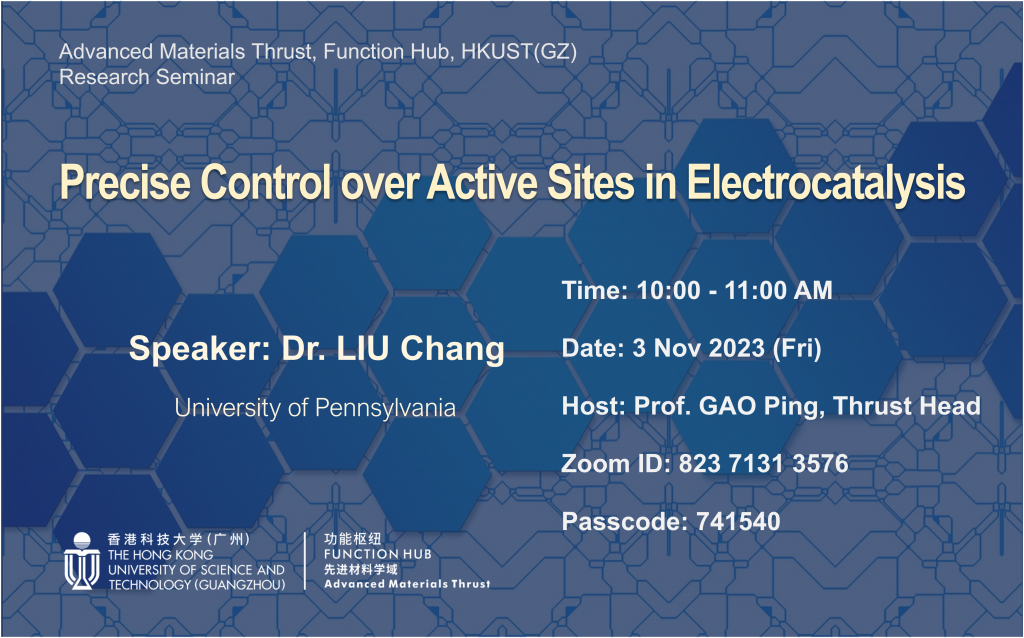
Public Research Seminar by Advanced Materials Thrust, Function Hub - Precise Control over Active Sites in Electrocatalysis
Supporting the below United Nations Sustainable Development Goals:支持以下聯合國可持續發展目標:支持以下联合国可持续发展目标:
Rational design and synthesis of efficient catalysts are paramount to the development of electrochemical devices for clean energy and fuel conversion. Heterogeneous catalytic materials are promising for the easy integration of electrochemical devices; however, the structural complexity of heterogeneous electrocatalysts makes it a great challenge to elucidate the surface catalytic sites and the reaction mechanisms. Our work is centered on the chemical synthesis of heterogeneous electrocatalysts with well-defined catalytic site and surface structures that enables the fundamental understanding of structure-property relationship for the design and production of improved electrocatalysts. Solution-based colloidal synthesis of nanocrystals provides an effective strategy to achieve atomically precise control of nanocrystal surfaces and interfaces as well as uniform sizes, shapes and compositions. The well-defined nanocrystals can be used as model catalysts with minimized structural complexity, leading to accurate qualitative and quantitative analyses of surface catalytic sites. Moreover, well-defined molecular catalysts are heterogenized and immobilized onto conductive carbon supports, which allows for the modulation of catalytic site coordination structure for the enhanced electrocatalysis. Based on this synthetic strategy, a series of core/shell and single-site nanocrystals are created for a variety of important electrocatalytic reactions, including the oxygen evolution reaction (OER) and the hydrogen evolution reaction (HER) for water electrolyzers and the oxygen reduction reaction (ORR) for alkaline exchange membrane fuel cells. The talk will also include the immobilization of Co and Ir molecular catalysts onto conductive carbon supports using novel non-covalent strategies, which allows the heterogenization of molecular catalysts for the OER.
Chang Liu is a postdoctoral researcher at the University of Pennsylvania under Prof. Thomas Mallouk and Christopher Murray. He received his Ph. D. in inorganic chemistry in 2021 at the University of Virginia under advisor Prof. Sen Zhang. His research interests are in well-defined catalytic centers construction and clean energy conversion in the electrocatalysis approach, such as water splitting, fuel cell reactions and CO2-to-fuel conversion. He was named Jefferson Fellow by Jefferson Scholar Foundation (2021), the Adam Ritchie Award by University of Virginia (2021), graduate student award by the Materials Research Society (2021) and Future Investigator Spotlight by ACS Energy and Fuel Division (2023).