Public Research Seminar by Advanced Materials Thrust, Function Hub - Managing Light-matter Interactions: From Single Nanoparticle Analysis to Controlled Assembly

Supporting the below United Nations Sustainable Development Goals:支持以下聯合國可持續發展目標:支持以下联合国可持续发展目标:
Surface plasmon resonance in metal nanoparticles can be engineered to absorb specific photons, producing hot carriers. This process allows for controlled photocurrent generation and selective photocatalytic reactions in plasmonic nanomaterials. I have utilized Stokes and anti-Stokes emission spectroscopy to study hot carriers in single gold nanorods. The energy distribution of these carriers, which influences the emission spectral lineshape, can be adjusted by varying the excitation wavelength and power. Effective carrier temperatures are derived from anti-Stokes emission, and single-particle spectroscopy is further applied to investigate photoexcited d-hole dynamics in catalytically important plasmonic copper nanocubes.
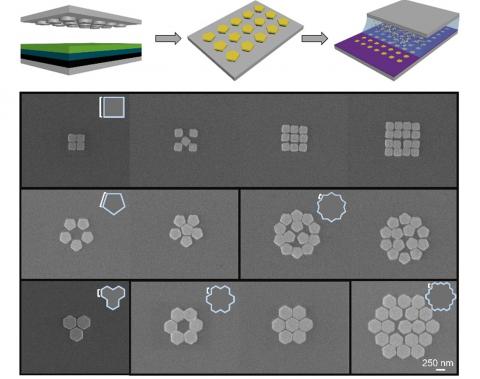
To enhance control over light-matter interactions through nanoparticle assemblies, I have developed a top-down lithographic process to produce nanoparticles with exact sizes, shapes, and compositions, circumventing the constraints of wet-chemical synthetic methods. Using a template-assisted assembly technique, nanoparticles are organized into open or close-packed structures or nanoparticle metamolecules according to size- and shape-engineered templates. The plasmonic resonances of polygonal-shaped Au nanoparticles are harnessed to connect the structure and optical properties of these assemblies. Comparisons between open- and close-packed structures show that adding a central nanoparticle to closed-packed assemblies promotes collective interactions and alters magnetic optical modes and Fano resonances. Moreover, reducing the distance between nanoparticles enhances the strength of plasmonic coupling, and the structural symmetries of the nanoparticle metamolecules dictate the orientation-dependent scattering response.
Yi-Yu Cai is a postdoctoral researcher in Prof. Cherie R. Kagan’s group in the Department of Electrical Engineering at the University of Pennsylvania. He received his Ph.D. in Physical Chemistry under the supervision of Prof. Stephan Link from Rice University in August 2019. In March 2014, he obtained his M.S. in Chemistry from Shanghai Jiao Tong University advised by Prof. Jie-Sheng Chen and Prof. Xin-Hao Li. He completed his B.S. in Chemistry in June 2011 at Jilin University.
His work takes an interdisciplinary approach to solving energy and sustainability issues. His expertise encompasses single particle spectroscopy, nanofabrication, electromagnetic simulation, nanosynthesis, and catalysis. To date, he has published twenty-eight research papers and two patents, with total citations reaching 1312. These include first-author publications in journals such as Advanced Materials, Angewandte Chemie, ACS Energy Letters, Nano Letters, and ACS Nano.
His educational and teaching experiences have prepared him for instructing inorganic, physical, and instrumental chemistry courses, as well as graduate-level classes on nanotechnology and spectroscopy.