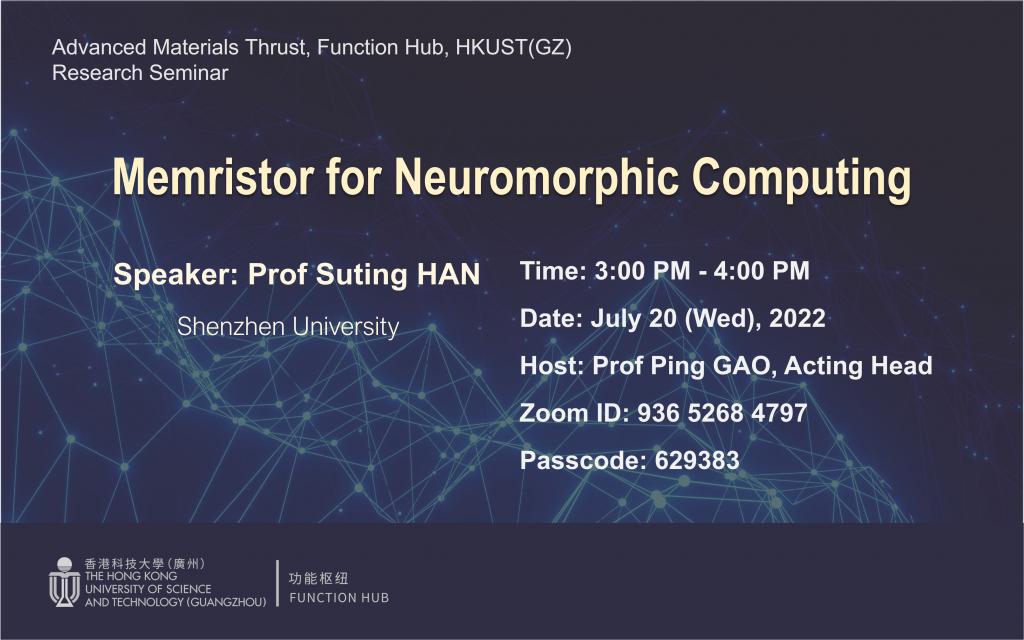
Public Research Seminar by Advanced Materials Thrust, Function Hub, HKUST(GZ) - Memristor for Neuromorphic Computing
Supporting the below United Nations Sustainable Development Goals:支持以下聯合國可持續發展目標:支持以下联合国可持续发展目标:
Inspired by the human brain which is a tremendously dense neural networks including ~1011 neurons connected by ~1015 synapses with parallel information processing, memorizing and learning capability, the software-based neural network has achieved huge breakthroughs in the artificial intelligence and Internet-of-things for the past few decades. However, since the implementation of neural network is still based on the von Neumann architecture, great amount of data shuffled between central processing units and main memory during training and inference processes induces the latency issue and low power efficiency. To obtain comparable capabilities of human brain which could operate at petaflop with power consumption less than 20 W, implementation of neural network in hardware with constrained power and chip area is highly desired.
Memristor has attracted much attention due to its high integration density (4F2, 3D stackable), extremely fast operation speed (< 10 ns), CMOS technique compatibility, and unique conductance modulation dynamics. Memristor is an emerging two-terminal electronic element with adjustable conductance, which has been extensively studied in emerging fields, such as bio-inspired computing and machine learning acceleration. In this seminar, the memristor for the application of neurmorphic computing will be introduced.
Prof. Su-Ting Han is a distinguished Professor in the College of Electronics and Information Engineering at Shenzhen University. She received Ph.D. in Physics and Materials Science from City University of Hong Kong, Hong Kong SAR in 2014. From 2014 to 2016, she was a postdoctoral research fellow at City University of Hong Kong. She joined Shenzhen University in 2016 as associate professor (tenure track) and was promoted to full professor (tenured) in 2021 and then distinguished professor in 2022. She was visiting professor in department of electrical engineering and computer science at the University of Michigan, US in 2019. Her research interest includes flash memory, memristor, neuromorphic computing and in-memory computing systems. To date Prof. Han has published over 100 journal articles with 6,400 citations and h-index of 43 (Google Scholar) as first and corresponding author. She is the reviewer for over 50 journal including Science, Nature, Nature Review Physcis, Nature Electronics, Science Advances, Nature Communications etc. Prof. Su-Ting Han is an editorial board member of Nano Futures (Impact factor 3.306). She is an awardee of NSFC Excellent Young Scientist Fund (國家優青) and she has been listed as world's top 2% scientists by Stanford University (2019 and 2020).