Supporting the below United Nations Sustainable Development Goals:支持以下聯合國可持續發展目標:支持以下联合国可持续发展目标:
ABSTRACT
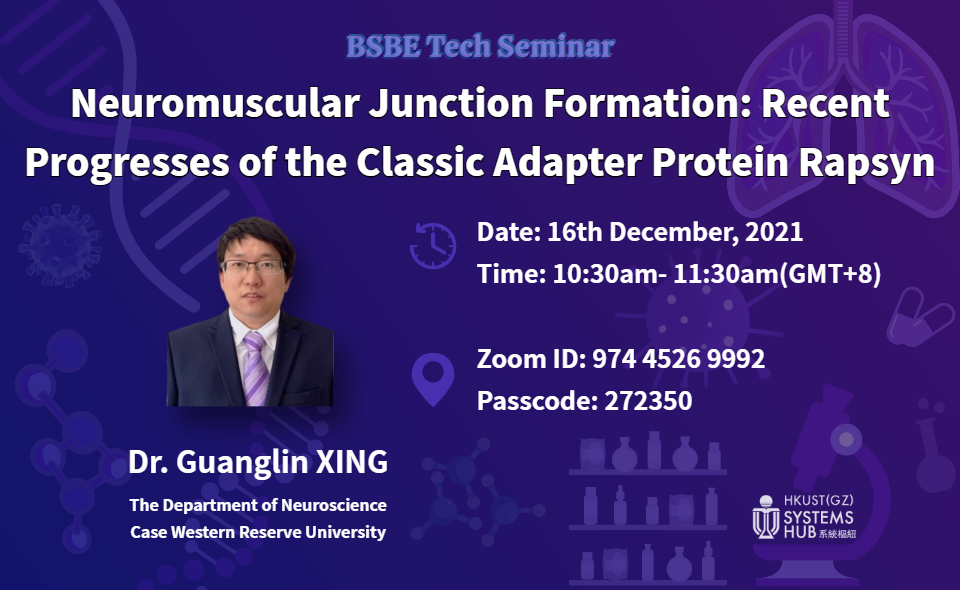
Neuromuscular junctions (NMJs) are synapses formed between motoneurons and muscle fibers, and characterized with high density of acetylcholine receptors (AChRs) at postsynaptic membrane. Rapsyn, a postsynaptic adaptor protein, anchors AChR to the cytoskeleton and induces AChR cluster formation. Our recent result shows that rapsyn is an E3 ligase which neddylates subunits of AChR and promotes AChR clustering. However, how these processes are regulated remains unclear. To this end, we firstly focus on rapsyn mutations identified in congenital myasthenia syndromes (CMSs), a group of heterogeneous NMJ disorders characterized with muscle weakness and fatigues. Through studying disease-related mutation, we found that rapsyn become tyrosine-phosphorylated in response to upstream signaling. Phosphorylation of rapsyn promotes its self-association and E3 ligase activity and thus promotes AChR clustering, suggesting a signaling molecule of rapsyn. Moreover, we combined biochemical assay with cellular culture and in vivo assay and found that rapsyn undergoes liquid-liquid phase separation (LLPS) and condensates into liquid-like assemblies. Such assemblies can recruit AChRs, cytoskeletal proteins, and signaling proteins for postsynaptic differentiation, revealing a novel mechanism of rapsyn in postsynaptic assembly.
BIOGRAPHY
Dr. Xing obtained his Ph.D degree from Southeast University at 2014, and then moved to Dr. Lin Mei’s lab to pursue postdoc training. His Ph.D work focused on autism-related gene, neuroligin. Through studying neuroligin mutant flies, he provided in vivo evidence that neuroligin 3 is critical for synaptic maturation. Moreover, he dissected the molecular mechanisms of neuroligins in synapse formation and found a critical role of neuroligin 1 in the postsynaptic actin cytoskeleton organization. During his time in the Dr. Mei lab, he studied postsynaptic adapter protein, rapsyn, and found rapsyn is a signal molecule, in addition to adapter protein. Recently, he found that rapsyn undergoes liquid-liquid phase separation (LLPS) and condensates into liquid-like assemblies which is critical for acetylcholine receptor (AChR) clustering and postsynaptic assembly, revealing a novel mechanism of rapsyn in synapse formation. Until now, he published 5 papers as the first-author, one Neuron paper, two eLife papers, one Journal of Biological Chemistry, and one review paper in Neuroscience Letter.