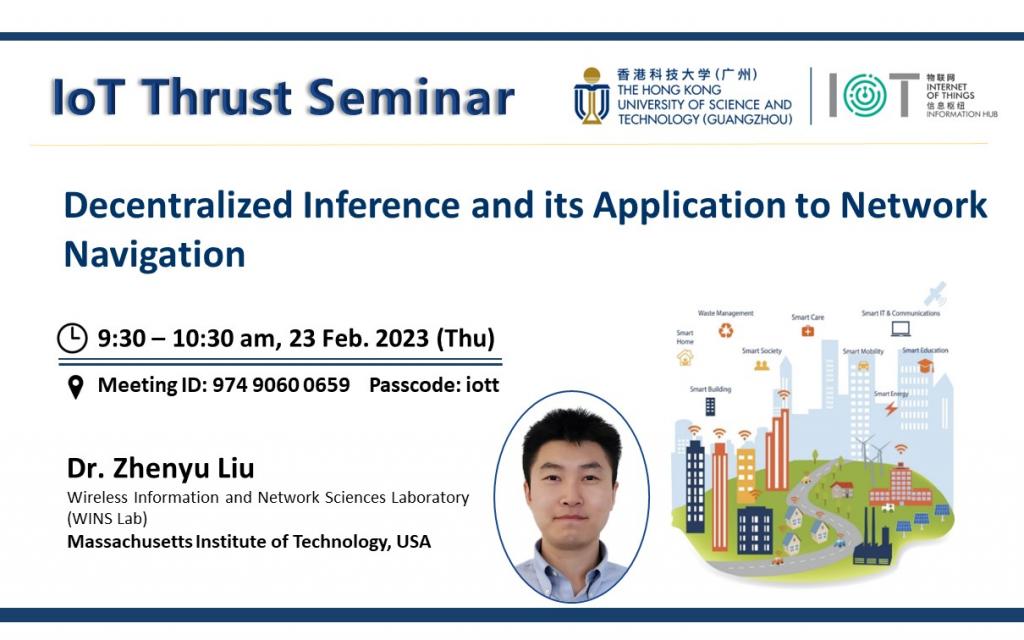
IoT Thrust Seminar | Decentralized Inference and its Application to Network Navigation
Supporting the below United Nations Sustainable Development Goals:支持以下聯合國可持續發展目標:支持以下联合国可持续发展目标:
Decentralized inference is critical in several emerging applications such as Internet of Things, intelligent connected vehicles, and network navigation. The aim of decentralized inference is to estimate time-varying states via multi-modal sensing and inter-node communication in networked systems. However, decentralized inference is challenging due to multiple factors such as sensing noise, communication failures, and computing latency.
In this seminar, the speaker presents his research results on decentralized inference and network navigation. The first part of the seminar introduces a theoretical framework for decentralized inference, where multiple nodes in a network aim to infer their unknown states in real time under sensing and communication constraints. Specifically, conditions on the network’s sensing and communication capabilities for achieving desirable inference accuracy are derived, and techniques for inter-node communication and decentralized estimation are developed. The second part of the seminar presents systems for network navigation, where commercially available devices are used for inferring users’ positions in real time. These systems perform information fusion via belief propagation and employ spatial cooperation among users for improving positioning accuracy. Finally, the speaker concludes the seminar with his plan for future research.
Zhenyu Liu received the Ph.D. degree in networks and statistics from the Massachusetts Institute of Technology (MIT), Cambridge, MA, USA, in 2022. He received the B.S. degree (with honor) and M.S. degree in electronic engineering from Tsinghua University, Beijing, China, in 2011 and 2014, respectively. Currently, he is a postdoctoral associate in the Laboratory for Information and Decision Systems at MIT. His research interests include Internet of Things, network localization, decentralized inference, wireless communication, networked control, and quantum information science. He received the First Prize of the IEEE Communications Society’s Student Competition in 2016 and 2019, the R&D 100 Award for Peregrine System in 2018, and the Best Paper Award at the IEEE Latin-American Conference on Communications in 2017. He served as a reviewer for various IEEE journals and international conferences.