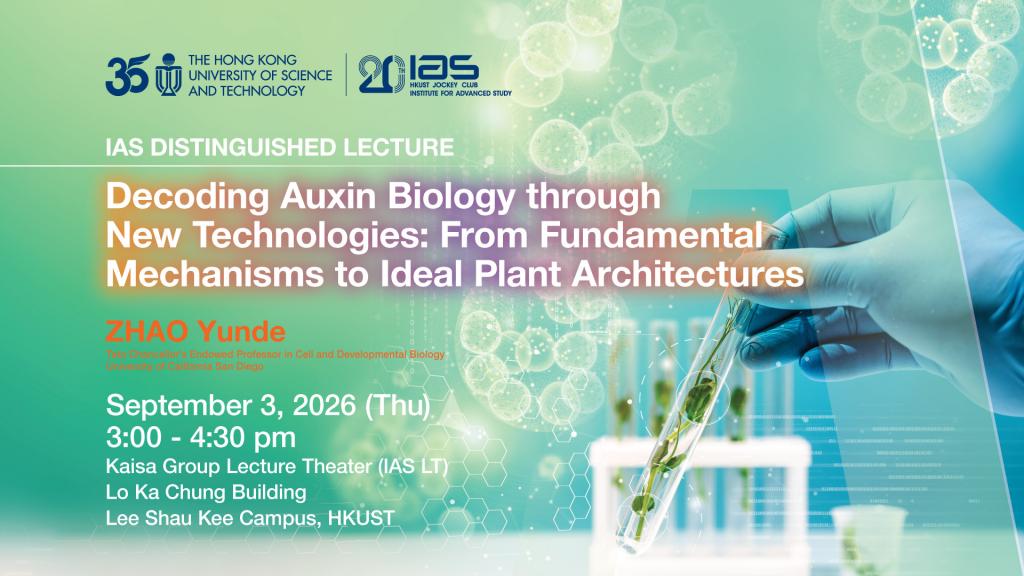
IAS Distinguished Lecture - Decoding Auxin Biology through New Technologies: From Fundamental Mechanisms to Ideal Plant Architectures
Supporting the below United Nations Sustainable Development Goals:支持以下聯合國可持續發展目標:支持以下联合国可持续发展目标:
Abstract
Auxin is a fundamental hormone that orchestrates nearly every aspect of plant growth and development. For decades, the precise biochemical pathways converting tryptophan to indole-3-acetic acid (IAA) remained a central mystery in plant biology. In this lecture, the speaker will discuss the definitive discovery of the YUCCA mediated auxin biosynthesis pathway by his laboratory and its essential role in plant organogenesis. He will further explore how these fundamental discoveries have paved the way for advanced synthetic biology applications. The speaker will highlight the latest technological breakthroughs, including the RUBY reporter system. This system utilizes betalain biosynthesis to provide a visible and non-destructive marker for transformation. He will also discuss innovative CRISPR/Cas9 strategies for generating transgene-free and genetically stable edited crops. These tools are currently revolutionizing both basic research and the engineering of climate-resilient agricultural traits. The lecture will conclude with a vision for the future of Synthetic Plant Architectures. This is a field where precise control over hormonal pathways and genomic regulatory toolboxes enables the design of crops with enhanced yields and environmental adaptability.
About the Speaker
Prof. ZHAO Yunde is a Tata Chancellor’s Endowed Professor in the Department of Cell and Developmental Biology, University of California San Diego (UCSD). He is the current Editor-in-Chief of Plant Physiology, which is one of the most prestigious plant biology journals.
Prof. Zhao is known for his contribution to solving the complete auxin biosynthetic pathway in plants. He played a leading role in demonstrating that local auxin biosynthesis is essential for plant development. He is also recognized for his inventions of several gene editing-related technologies including ribozyme-based guide RNA production and the Transgene-Killer CRISPR technology, which have been widely used by scientists around the world. His recent invention of RUBY, a synthetic gene for betalain synthesis, greatly simplifies plant transformation and visualization of gene expression. His discoveries have been included in textbooks in three different fields: Plant Physiology and Development; Organic Chemistry; and Plant Biotechnology and Genetics.
Prof. Zhao received his PhD in Biochemistry from the University of Michigan, where he studied nitric oxide signaling mechanisms in animals. He received his postdoctoral training in the field of plant molecular genetics at the Salk Institute, where he was supported by a postdoctoral fellowship from the Howard Hughes Medical Institute and the Life Sciences Research Foundation. Prof. Zhao has been a Clarivate highly cited researcher since 2019 and he has received several awards including American Society of Plant Biologists (ASPB) Fellow, Fellow of Indian Society of Plant Physiology, the Japan Society for the Promotion of Science professor fellowship, Fellow of AAAS (American Association for the Advancement of Science), and Senior member of National Academy of Inventors. He has published 143 publications with total citation of 26270, H-index 76.
For Attendees' Attention
Seating is on a first come, first served basis.