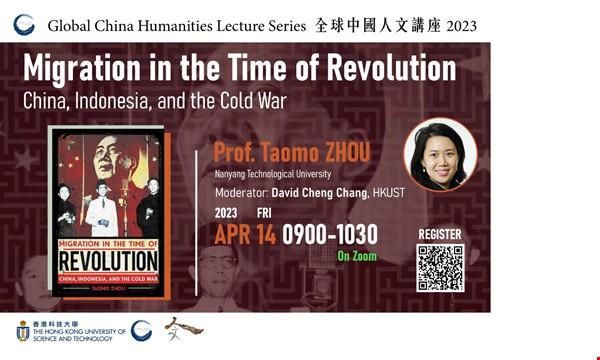
Global China Humanities Lecture Series 全球中國人文講座2023 - Migration in the Time of Revolution: China, Indonesia, and the Cold War
Supporting the below United Nations Sustainable Development Goals:支持以下聯合國可持續發展目標:支持以下联合国可持续发展目标:
What happens when geostrategic collaborations between states intersect with ethnic tensions? In response to this question, this talk examines how two of the world’s most populous countries interacted between 1945 and 1967, when the concept of citizenship was contested, political loyalty was in question, national identity was fluid, and the boundaries of political mobilization were blurred. Even though China and Indonesia do not share geographical borders, the existence of 2.5 million ethnic Chinese in Indonesia—many of whom had economic influence but an unclear citizenship status—gave rise to a porous social frontier. Through their everyday social, political and economic practices, “ordinary” Chinese diaspora influenced bilateral diplomacy. Their life experiences were shaped by but also helped shape the trajectory of governmental relations.
Biography:
Taomo Zhou is an Associate Professor of History at Nanyang Technological University (NTU), Singapore, specializing in modern Chinese and Southeast Asian history. Taomo received her Ph.D. from Cornell University. Her writings have appeared in journals such as Diplomatic History, Journal of Asian Studies, and The China Quarterly. Taomo’s first book, Migration in the Time of Revolution: China, Indonesia and the Cold War (Cornell University Press, 2019), won a Foreign Affairs “Best Books of 2020” award and an Honorable Mention for the 2021 Harry J. Benda Prize from the Association for Asian Studies. Taomo is currently working on her second book project tentatively entitled “Made in Shenzhen: A Global History of China’s First Special Economic Zone,” which is under contract with Stanford University Press.