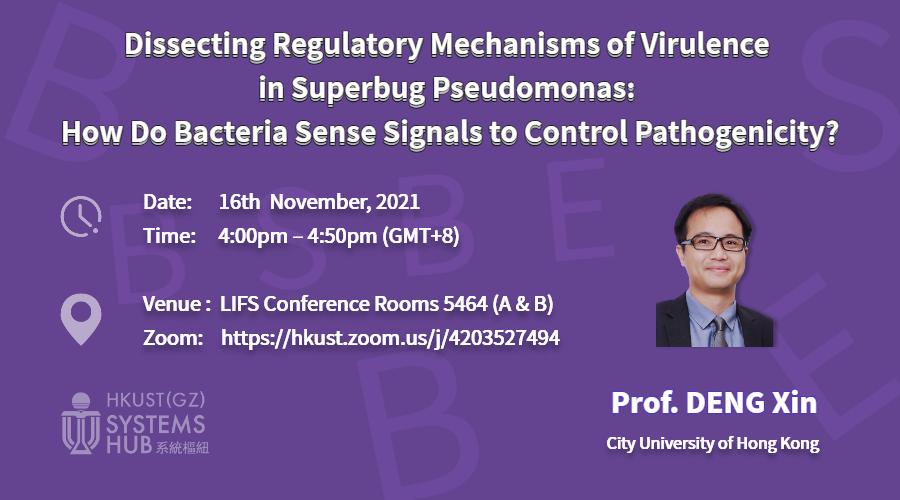
Dissecting Regulatory Mechanisms of Virulence in Superbug Pseudomonas: How do Bacteria Sense Signals to Control Pathogenicity?
Supporting the below United Nations Sustainable Development Goals:支持以下聯合國可持續發展目標:支持以下联合国可持续发展目标:
Abstract
The emergence and spread of various multidrug-resistant bacterial strains have posed alarming challenges to public health and agriculture worldwide. Public demand for new antibiotics is enormous, yet drug development pipelines of the pharmaceutical industry started to run dry with limited targets available for inventing new bactericidal antibiotics. It is important to uncover potential therapeutic targets. Our lab has been working on virulence regulation in the human pathogen Pseudomonas aeruginosa and plant pathogen Pseudomonas syringae, which are of world-wide importance. These pathogens rely on quorum sensing (QS) systems and type III secretion system (T3SS) to invade their hosts, which is finely regulated by a group of transcription factors (TF), two-component systems (TCS, ‘bacterial nervous system’) and signaling pathways. Research in our group has led to the identification of a variety of new virulence factors and their molecular mechanisms. Specifically, we have characterized the signal cascade of RhpRS-hrpR-T3SS, that is targeted by host polyphenols. We also found that RNA epigenetic marks (such as m6A and rG4) play important roles in regulating bacteria virulence. We have mapped the complicated TF-based regulatory networks for both superbugs, which identify a group of master virulence regulators. Tuning their expression and developing inhibitors are key for the development of strategies to control Pseudomonas infections.
Biography
Dr. Deng received his Bachelor and Master degrees in Microbiology from China Agricultural University. He completed his PhD in Genetics at the Kansas State University in 2009, and his postdoctoral training in Prof. Chuan He’s lab at the University of Chicago in 2015. He worked in Nankai University before joined City University of Hong Kong in 2017, and was promoted to Associate Professor and Associate Head at the Department of Biomedical Sciences. He is interested in bacterial virulence, including gene regulation, signaling pathways, and RNA epigenetics. His research lies on the interface of multi-disciplinary approaches with the ultimate goal of developing novel therapies to combat bacterial infections.