Department of Mathematics - Mathematics Colloquium - Theory of FPCA for Discretized Functional Data
Supporting the below United Nations Sustainable Development Goals:支持以下聯合國可持續發展目標:支持以下联合国可持续发展目标:
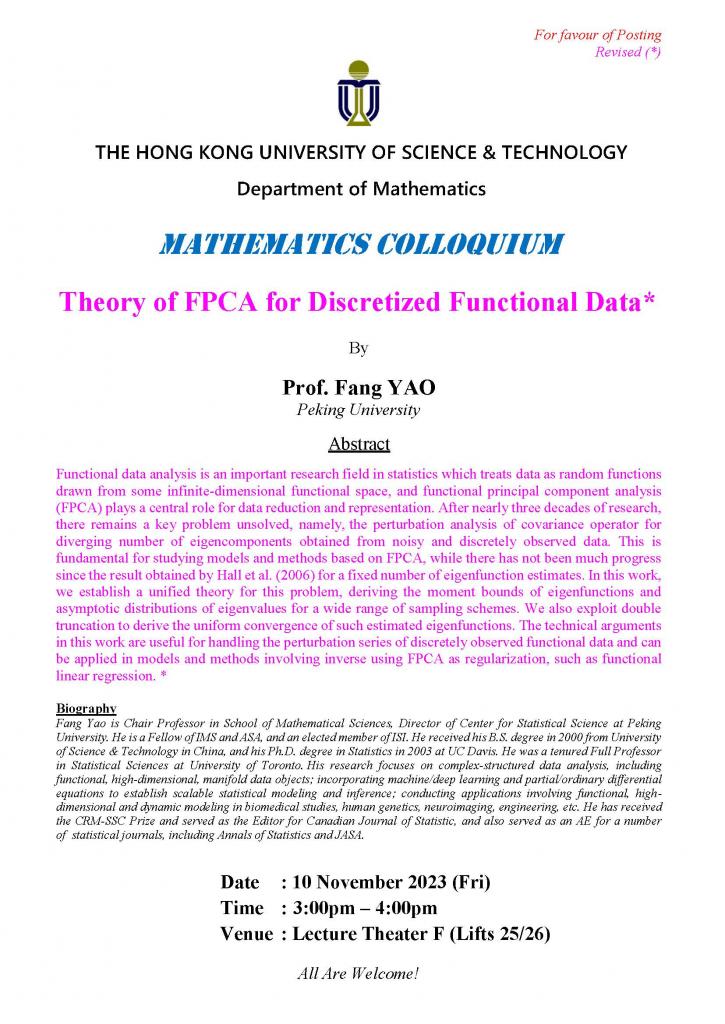
Functional data analysis is an important research field in statistics which treats data as random functions drawn from some infinite-dimensional functional space, and functional principal component analysis (FPCA) plays a central role for data reduction and representation. After nearly three decades of research, there remains a key problem unsolved, namely, the perturbation analysis of covariance operator for diverging number of eigencomponents obtained from noisy and discretely observed data. This is fundamental for studying models and methods based on FPCA, while there has not been much progress since the result obtained by Hall et al. (2006) for a fixed number of eigenfunction estimates. In this work, we establish a unified theory for this problem, deriving the moment bounds of eigenfunctions and asymptotic distributions of eigenvalues for a wide range of sampling schemes. We also exploit double truncation to derive the uniform convergence of such estimated eigenfunctions. The technical arguments in this work are useful for handling the perturbation series of discretely observed functional data and can be applied in models and methods involving inverse using FPCA as regularization, such as functional linear regression.
Fang Yao is Chair Professor in School of Mathematical Sciences, Director of Center for Statistical Science at Peking University. He is a Fellow of IMS and ASA, and an elected member of ISI. He received his B.S. degree in 2000 from University of Science & Technology in China, and his Ph.D. degree in Statistics in 2003 at UC Davis. He was a tenured Full Professor in Statistical Sciences at University of Toronto. His research focuses on complex-structured data analysis, including functional, high-dimensional, manifold data objects; incorporating machine/deep learning and partial/ordinary differential equations to establish scalable statistical modeling and inference; conducting applications involving functional, high-dimensional and dynamic modeling in biomedical studies, human genetics, neuroimaging, engineering, etc. He has received the CRM-SSC Prize and served as the Editor for Canadian Journal of Statistic, and also served as an AE for a number of statistical journals, including Annals of Statistics and JASA.