Department of Industrial Engineering & Decision Analytics [Joint IEDA/ISOM] seminar - When Strategic Customers Meet Strategic Servers: Individual and Social Optimization in Many-Server Queueing Systems
Supporting the below United Nations Sustainable Development Goals:支持以下聯合國可持續發展目標:支持以下联合国可持续发展目标:
We initiate the study of joint strategic behavior of customers and servers in many-server queueing systems. We model customers as strategic agents who decide whether to join the system by weighing reward from service against cost of waiting, following the seminal works of Naor (1969) and Knudsen (1972). In those works, customers use a threshold equilibrium joining strategy based on the number of customers already in the system (whereas servers operate at fixed exogenous rates). Moreover, customers "over-join" (that is, induce a higher threshold) compared to the socially optimal threshold, a result known as Naor's inequality. Although Naor's inequality is known to hold widely in queueing systems with strategic customers, no work has considered whether or not it holds when servers are also strategic (specifically, in choosing how fast to work). We investigate this question within a large-system asymptotic framework when servers choose service rates to balance reward and effort cost.
We show that at equilibrium, customers may either over-join or under-join the system (that is, induce a higher or lower threshold than the socially optimal one), an observation that challenges the universality of Naor's inequality. Next, we compare the welfare of customers and servers under the social optimum and an individual equilibrium and find the following imbalance: While customers always benefit when moving from an equilibrium to the social optimum, servers may end up experiencing reduced and even negative utility. Finally, we propose an incentive scheme that charges an entry fee from customers and offers a performance-based compensation for servers, which realigns individual incentives with social optimum. The incentive scheme is feasible (that is, does not require external subsidy) when the number of servers is sufficiently small. Surprisingly, under the optimal incentive scheme, the welfare distribution remains imbalanced but towards the opposite party: Servers always benefit, while customers sometimes incur welfare losses.
This is joint work with Yueyang Zhong (LBS); Raga Gopalakrishnan (UCB)
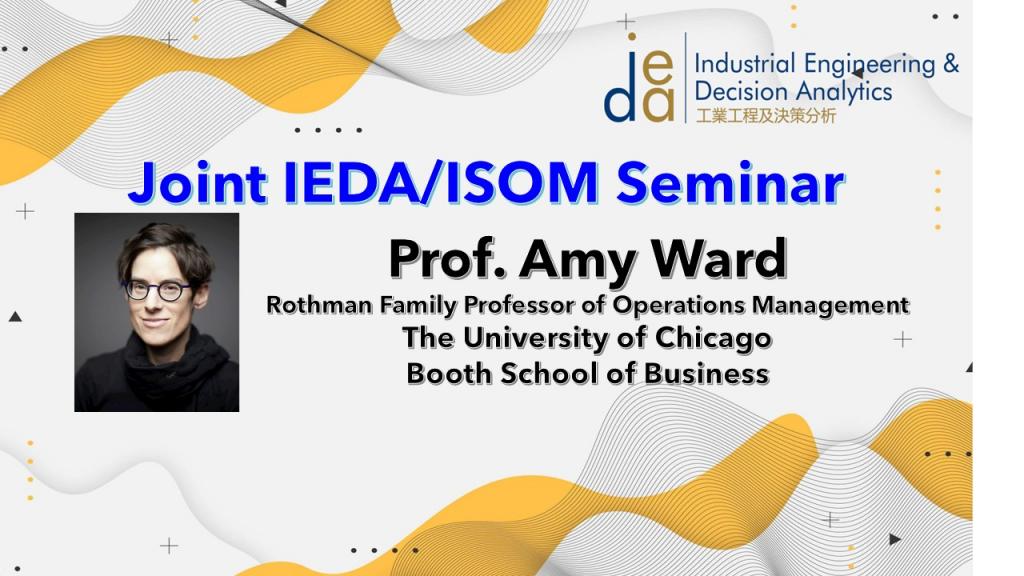
Amy R. Ward is the Rothman Family Professor of Operations Management at the University of Chicago Booth School of Business. She received her Ph.D. degree from Stanford University in 2001. She is a fellow of the INFORMS Manufacturing and Service Operations Management (M&SOM) Society (elected June, 2023). She is the Editor-in-Chief for the journal Operations Research (term began 1/1/2024). Earlier, she held the position of Chair of the INFORMS Applied Probability Society (term 11/2016-11/2018).